

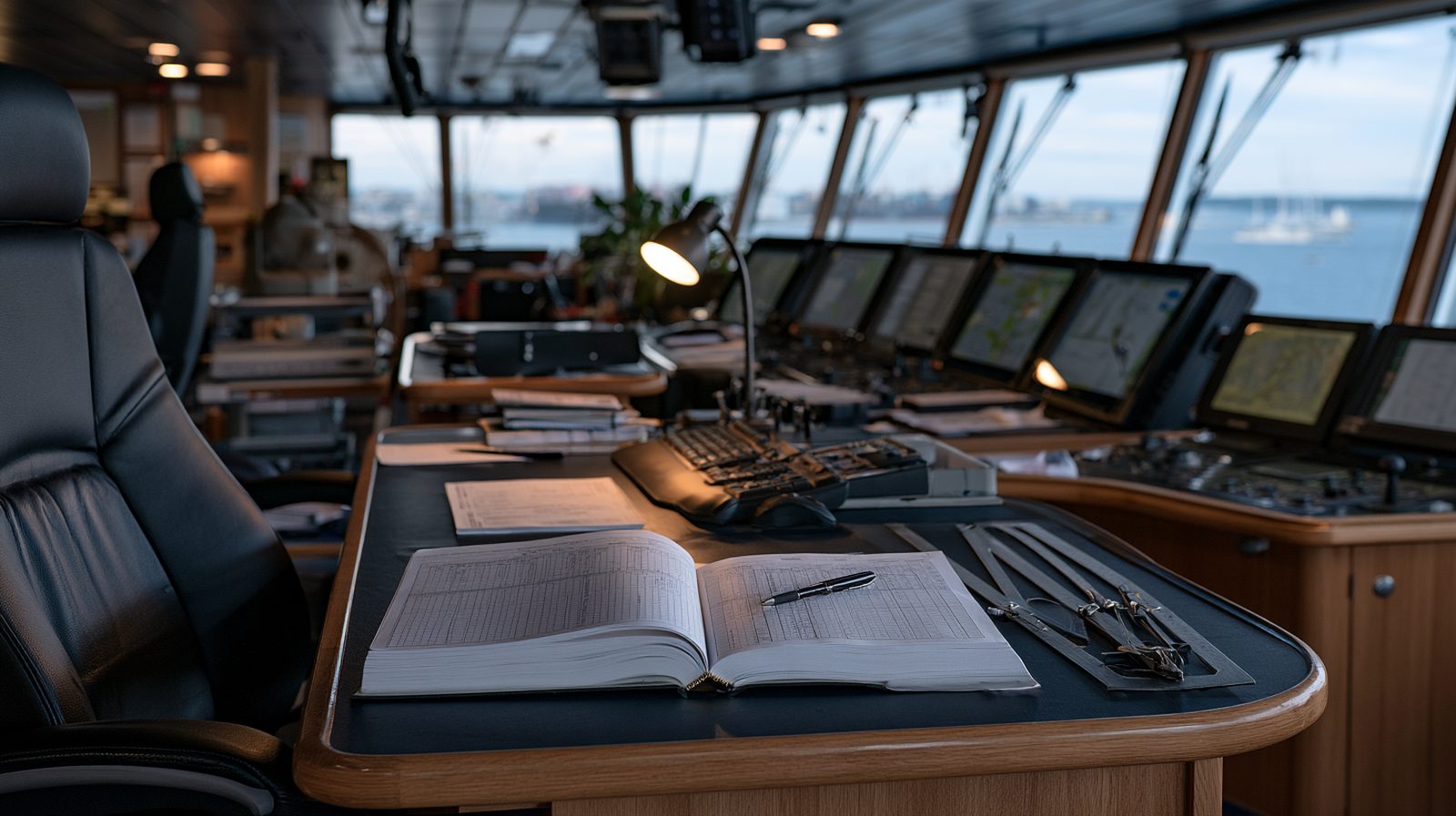


The logbook is the chronological register of the life of a vessel: positions, courses, weather conditions, settings, counter readings and notable events, written down as the passage unfolds. Many leisure sailors see it as one more administrative formality. It is in fact the only document that makes it possible, after the event, to reconstruct what actually happened on board — for an insurer, for customs, for a marine surveyor, or for yourself on the day you are trying to work out why a part failed.
This guide covers the regulatory framework, the contents line by line, a genuinely completed example page, the choice of medium, what gives the document its evidential weight, and the point at which a paper book stops being enough.
Logbook, ship's log, deck log: what the words mean
In leisure boating the terms are interchangeable. Logbook, ship's log and deck log all describe the same thing: the register of how the vessel was handled, kept by the skipper. French regulations use the words journal de bord, and everyday French usage adds livre de bord and carnet de bord for the more informal version kept for the memories.
On a commercially operated ship the distinction becomes real and enforceable. The deck logbook records the navigational side: positions, courses, watches, manoeuvres, events at sea. The engine room logbook is a separate register covering the propulsion plant and the auxiliaries: running hours on the main engines and generators, temperatures and pressures read off, oil top-ups, fuel transfers, safety trials, starting air compressor runs. Two registers, two logics, two people responsible — the master on one side, the chief engineer on the other.
The separation is not academic. It explains how an inspector can accept a faultless deck log and raise a finding on a poorly kept engine log in the same visit. We covered that second register and what surveyors look for in our article on the digital engine room logbook.
Is a logbook mandatory?
The answer depends on what the vessel is used for and what flag it flies. There are two distinct regimes, and they should not be confused.
Commercial ships: SOLAS and the ISM Code
For ships in commercial service the logbook is not an option. SOLAS chapter III requires records of musters, drills and inspections of life-saving appliances to be kept and entered in the ship's log book. SOLAS chapter IX makes the ISM Code mandatory, and the ISM Code in turn shifts the logbook from a personal tool to a component of the safety management system.
The Code prescribes no particular form. Chapter 10 requires the company to establish procedures for the maintenance of the ship and its equipment, and to keep the corresponding records. Chapter 12 organises internal verification: audits, company review, corrective action. In practice the auditor does not simply note that a job was done. They check that it is recorded, dated, assigned to someone, and consistent with the counters read off. A log showing 4,200 engine hours in January and 4,150 in March opens a non-conformity on its own.
That kind of inconsistency does not arise when the counter is read once, on board, and that reading is what feeds the equipment history. It is the principle behind our counter readings, captured from the phone, offline.
Pleasure craft under the French flag: Division 240
For recreational boats registered in France, a logbook becomes mandatory as soon as you sail beyond 6 nautical miles from shelter. The requirement comes from article 240-2.05 of Division 240, which calls for an up-to-date logbook containing the information relevant to monitoring the passage and the safety of the vessel. The obligation starts in the semi-offshore category and continues offshore.
Division 240 is French national law. It applies to pleasure craft of less than 24 metres in personal use flying the French flag — it is not an international rule, and it does not bind vessels under other flags.
| Navigation category | Distance from shelter | Logbook |
|---|---|---|
| Basic | Less than 2 nautical miles | Not required |
| Coastal | 2 to 6 nautical miles | Not required, but recommended |
| Semi-offshore | 6 to 60 nautical miles | Mandatory (art. 240-2.05) |
| Offshore | Beyond 60 nautical miles | Mandatory |
Other flags, and the case for keeping one anyway
If your boat flies another flag, check what your own flag State requires — the thresholds and the wording differ from one register to the next. And where nothing obliges you, the absence of an obligation is a poor reason to do without. Coastal sailing is precisely where the small defects occur, and those are the ones that get forgotten because nobody wrote them down. A propeller strike on a floating line, a temperamental starter motor, a weeping stern gland: three lines in a log, and six months later you know how long the symptom has been there.
If you want a form to fill in straight away, our printable logbook template covers every heading described below, with a worked example page.
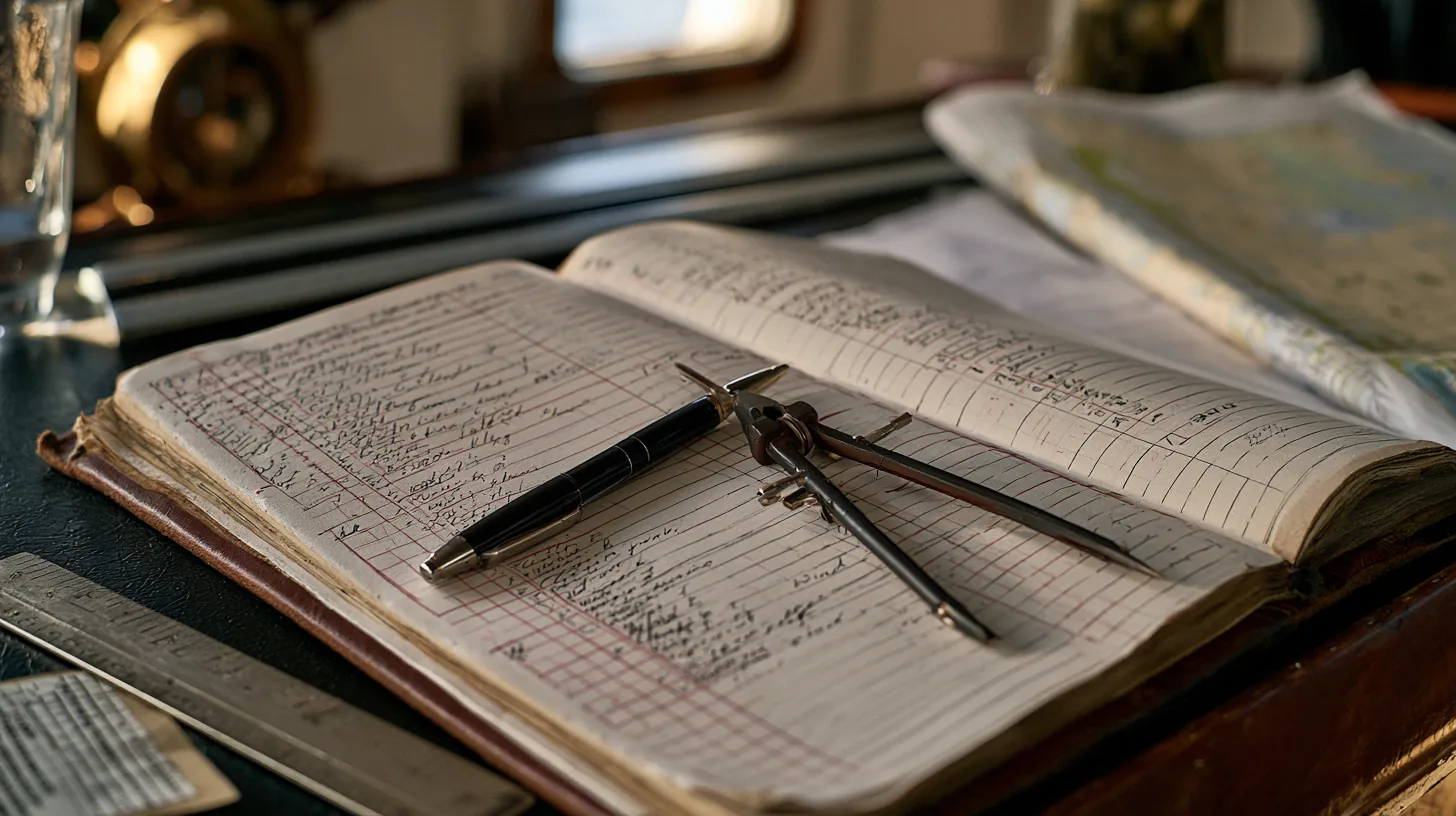
What a logbook must contain, line by line
The test is simple: your logbook must allow a third party to reconstruct the passage hour by hour. It is made up of three blocks.
Permanent information
Filled in once, on the first page, and left alone afterwards: vessel identification (name, registration, type, length, flag), the owner's contact details and insurance policy number, engine details together with the running-hours reading at the start of the season, and the list of regular crew with emergency contacts ashore.
That page earns its keep twice: day to day, to find a number without hunting for it, and on the day of a claim, to give the insurer immediately the references they need.
Pre-departure checks
This is the section most often neglected, and the one that protects you best. Recording that the safety equipment has been checked, that the weather was consulted at a given time and from a given source, that levels have been topped up and that the crew has been briefed establishes proof of due diligence. After an incident, that page carries real weight.
The minimum: safety equipment (lifejackets, flares, liferaft, extinguishers), VHF and navigation lights tested, fuel, fresh water and gas levels, crew briefing including the man-overboard procedure, passage plan with destination, intended route, bolt-holes and estimated times, and finally the weather bulletin with its source and time of issue.
The navigation record
| Entry | What you record | Why it matters |
|---|---|---|
| Date and time | Watch start and end times, local or UTC — but always the same one | Reconstructs the chronology, essential in any investigation |
| Position | GPS coordinates or dead-reckoning position, with the method used | Lets you fall back on dead reckoning if the electronics fail |
| Course and track | Course steered, course over ground, and the difference if you are being set | The basis for route calculation and estimated time of arrival |
| Speed | Speed through the water from the log, speed over ground from the GPS | The gap between the two measures the actual current |
| Observed weather | Wind direction and force, visibility, barometric pressure | The barometric trend announces the change before it arrives |
| Sea state | Swell height and direction, wind sea, Douglas scale | Explains hull damage or a fall on board |
| Settings and manoeuvres | Sail plan carried, reefs taken, or engine revolutions and the running-hours reading | The hours counter triggers servicing and can never be reconstructed afterwards |
| Consumption and levels | Fuel remaining, fresh water used, battery voltage | A drift in consumption points to a fouled hull or a clogging filter |
| Crew and watches | Persons on board, composition of the watch, handover times | Establishes who was responsible when, and who saw what |
| Events | Course changes, vessels sighted, hazards, damage, VHF calls | This is what turns a set of readings into a usable account |
Events, damage and incidents
Damage goes in the log even when it stops nothing. An unusual noise from a winch, a brief overheat, a navigation light that flickers, a halyard that slips: these are symptoms, and a dated symptom is worth a hundred vague recollections. Record the fact, the time, what you did about it, and whether the situation returned to normal.
The same applies to communications: a distress call overheard, contact with a coastguard station or a harbour office, a hazard reported by another vessel. These give the external context of your passage, and they are often exactly what the authorities look for when reconstructing an incident at sea.
A genuinely completed example
Here are six hours of a Marseille – Calvi crossing. The expected level of detail fits in one line per hour: facts, not a narrative.
| Time | Position | Course / Speed | Wind / Sea | Baro | Remarks |
|---|---|---|---|---|---|
| 06:00 | 43°17.4 N / 005°21.8 E | — | NE 3 / smooth | 1018 | Departed the Vieux-Port. Weather consulted at 05:30: NE 3 to 4. Fuel tank filled. Four persons on board. |
| 07:00 | 43°12.1 N / 005°28.6 E | 105° / 6.2 knots | NE 4 / slight | 1018 | Engine stopped, counter 1,342 h. Full mainsail and genoa. Commercial traffic passed 2 miles to port. |
| 08:00 | 43°09.8 N / 005°41.2 E | 102° / 6.8 knots | NE 4 / slight | 1017 | One reef taken as a precaution. Watch: Marc and Léa. Battery reading 12.6 V. |
| 09:00 | 43°07.5 N / 005°54.0 E | 100° / 7.1 knots | NE 5 / moderate | 1016 | Gusts to 24 knots. Second reef. Lifejackets and tethers for all. Position reported ashore by VHF. |
| 10:00 | 43°05.9 N / 006°07.3 E | 098° / 6.9 knots | NE 4 / moderate | 1016 | Unusual noise from the genoa sheet winch — to be inspected at the next stop. Nothing disabling. |
| 11:00 | 43°04.2 N / 006°20.8 E | 098° / 7.0 knots | NE 4 / slight | 1017 | Wind freeing, second reef shaken out. Fresh water: 40 l used since departure. Watch handover: Sophie and Marc. |
Look at the 10:00 line. The winch noise stops nothing, the passage continues, and yet it is recorded. That is exactly the kind of entry that gives a logbook its value: three months later, when the part really does fail, you know how long it had been showing signs — and if the insurer disputes it, you have a date.
Look at the 07:00 line too: the engine hours counter is there. It is the most useful figure in the whole book, and the most often left out. It can never be reconstructed. That is why in 91Â鶹¾«Ʒ the reading takes ten seconds from the phone and sets the next service due date itself, with no spreadsheet in between.
How often, who writes it, and the day nothing happens
Offshore, one line per hour is the rule, with a systematic entry at every change of watch. Semi-offshore, an hourly rhythm remains the right reflex as soon as the crossing runs beyond a few hours. Coastal, record departure, arrival and every notable event.
Who writes it? The skipper, as the person in charge, is responsible for the log, but the task can be delegated to the officer of the watch. Nominating someone on each watch is the best guarantee of regularity — and the fact that the handwriting changes from page to page is a good sign rather than a bad one: it shows the book was filled in as things happened, by different people, not copied out in one sitting.
And the day nothing happens? You fill it in anyway. It is counter-intuitive, but continuity is precisely what gives the register its value. A log in which only incidents appear suggests a poorly monitored boat; it is the routine lines that make the incidents readable. A quiet day at anchor takes one line: position, weather, counter, nothing to report, initials. Thirty seconds.
The golden rule, in every case, is to write as it happens. A logbook reconstructed from memory in the evening loses most of its value, and gives itself away immediately by its too-regular handwriting.
Paper book, app or printable template
| Criterion | Off-the-shelf paper logbook | App | Printable template |
|---|---|---|---|
| Cost | Fifteen to thirty euros or so | Free to a few euros a month | Free |
| Reliability on board | Total, no battery involved | Depends on battery life — carry a power bank | Total |
| Writing it up in a seaway | Difficult but workable | Fast if the interface is well designed | Difficult but workable |
| Automation | None | GPS track, weather and counters captured on their own | None |
| Backup | None — a soaked book is lost | Cloud, PDF export | To be photocopied or scanned |
| Customisation | Fixed headings | Varies | Total |
The 91Â鶹¾«Ʒ mobile app is built for the “reliability on board” row: it works with no network and syncs ashore. Its logbook module reproduces the layout of the paper register, fills in one-handed in a seaway and exports to PDF. It is free to try for 30 days, no card required, on a single boat.
The paper logbook remains unbeatable for reliability. Nautical publishers sell pre-formatted versions with all the useful headings. Its weakness is that it cannot be backed up: a book that goes over the side takes your history with it. Keep it in a waterproof wallet and write in indelible ink, never in pencil.
Apps automate what is tedious: the GPS track, the weather, the counter readings. They also let you share your position ashore in real time, which no paper book will ever do. Their limits are battery life, and the fact that you need to learn them before you leave, not while under way. Check too that they can produce a readable, exported document — that is what you will be asked for in an inspection.
The printable template is the best compromise to start with: free, customisable, and it forces you to decide for yourself what you want to track.
The 91Â鶹¾«Ʒ template
We have put together a printable logbook template, designed to fit on a chart table. The header block covers vessel, registration, date, skipper, port and time of departure, intended destination, crew on board, and the forecast consulted with its source and time. Below it sits the watch table: time, position, heading, speed, wind, sea state and visibility, barometer, sail plan or engine, remarks. One page carries a completed example line showing the expected level of detail; the other is blank, to photocopy as many times as you need. A footnote sets out how to correct a mistake without costing the document its evidential value. It is free to use.
The template comes in two formats, each a direct download, and both files are the French original — there is no separate English edition. The PDF is printed and filled in with a pen: it needs neither screen nor power and goes into a waterproof pouch. The spreadsheet is filled in from the keyboard: you can search back for a figure, add up engine hours or fuel used, and keep a backup copy off the boat.
- — PDF, 236 KB
- — Excel, 39 KB
Would you rather keep it on your phone than on paper? and record your counters, your defects and your pre-departure checks straight from on board. The history stays available even if the book itself ends up in the water.
What makes a logbook stand up to a surveyor or an insurer
A logbook has weight not because it exists, but because it is credible. A marine surveyor or an insurer looks at the form before reading a word of the content. A few simple rules are enough to pass that examination.
Write in indelible ink. A log in pencil is a log that can be altered, and therefore has no evidential value. The same goes for erasable ink pens, which are widespread and have no place on board.
Never scratch out a mistake. No eraser, no correction fluid, no torn-out page. An error is corrected with a single line that leaves the original value legible, the correct value written alongside, and your initials. A visible, owned correction strengthens the credibility of the document; a page scraped or whited out destroys it entirely, including the lines that had nothing wrong with them.
Maintain continuity. Numbered pages, consecutive dates, no missing page, no blank left between two entries. If you leave an empty space at the foot of a page, rule it through. An unexplained discontinuity is the first thing an opponent will point to.
Date it and initial it. Each page signed by the skipper or the officer of the watch. That is what ties an entry to a person, and therefore a responsibility to a moment in time.
Carrying those rules over to software
A spreadsheet meets none of these four conditions: it can be edited without leaving a trace, and that is exactly what strips it of any weight in a dispute. An app only does better if it was built for the job.
That is the design brief behind the 91Â鶹¾«Ʒ logbook module, which takes the four rules one by one. A validated line can no longer be modified or deleted, on the server as much as in the interface. An error is corrected by a rectifying entry: a new line that references the one being corrected and leaves it visible, exactly like the countersigned crossing-out in a paper register. Numbering is assigned by the server and never reused, so a missing line would leave a detectable gap. And signing a page does more than record a name and a date: the system freezes the line numbers covered and computes a fingerprint of their exact content.
Two things go further than paper allows. Every entry receives a digital fingerprint computed from its own content and from the fingerprint of the preceding entry, so the lines form a chain: altering an old line would break the fingerprint of every line after it. More importantly, the time of writing is recorded separately from the time of synchronisation. A line written at 03:15 offshore and transmitted at 11:40 at anchor stays dated 03:15, and the document says so — which is precisely what distinguishes an entry made as events happened from one reconstructed in the evening.
One qualification worth stating plainly: this amounts to a solid body of technical evidence, not an officially approved register. If your flag State requires a document in a particular form, check that before relying on software alone.
In practice, after damage, an insurer sets out to establish three things: what the conditions were, whether the vessel was properly handled, and whether there were warning signs beforehand. A logbook kept regularly answers all three. Its absence proves nothing against you — but it deprives you of any means of demonstrating your diligence. During a customs check or a verification by the maritime authorities, it substantiates your route and your port calls.
Seven mistakes that drain a logbook of its value
- Filling it in from memory. A log written up in the evening for the whole day loses its precision and its credibility.
- Recording only what goes wrong. It is the routine lines that make the incidents readable and the monitoring credible.
- Writing a narrative. Impressions and commentary have no place in the technical columns. Keep them for the keepsake section, separately.
- Forgetting the engine hours counter. It is the most useful entry and the most often omitted. It can never be recovered retrospectively.
- Correcting by erasing. A dated and initialled crossing-out is worth more than correction fluid, which casts doubt on the whole document.
- Mixing time references. Alternating local time and UTC without saying so makes the chronology unusable. Pick one, stick to it, and state it at the head of the register.
- Not backing it up. Photograph the completed pages at every stop, or use an . A single book is a single point of failure.
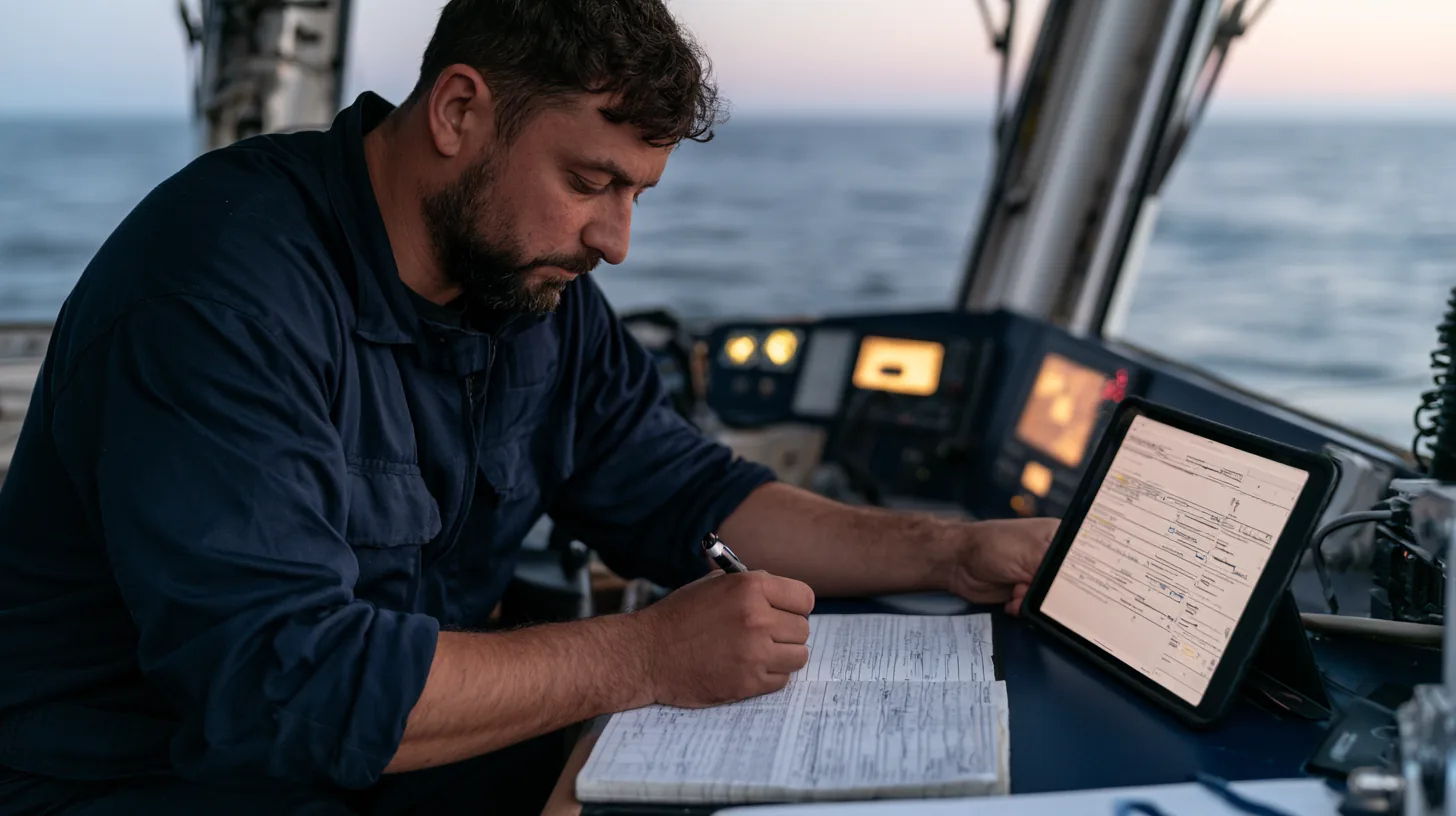
When one book is no longer enough
On one boat, a paper book is enough. The question changes in nature as soon as there are several vessels and crews that rotate.
The first symptom is always the same: nobody knows where the counters stand any more. Consolidating by hand the readings from six books, two of which stayed on board and one of which got wet, becomes impractical. Servicing intervals are then worked out by guesswork, and the gap between the theoretical oil-change hour and the real one widens without anyone noticing. The second symptom is the audit: when the inspector asks for the history of one specific piece of equipment over the last twelve months, finding it in a pile of books takes hours.
That is precisely the role of a marine CMMS: capture the data once on board, including offline, and deliver it consolidated ashore. Counter readings then trigger maintenance due dates automatically instead of being copied from a book into a spreadsheet. The same holds when the counter is entered from the logbook itself: the watch entry feeds the maintenance plan with no second capture. And consumption, logged line by line, becomes a usable indicator: that is the whole principle behind fuel consumption monitoring, and more broadly behind the move to condition-based maintenance, applied across a fleet rather than a single boat.
How long should you keep it?
No retention period is set by regulation for pleasure craft. The right reflex is to keep your logbooks at least as long as the limitation period applicable to your insurance contract runs, and to keep indefinitely the pages covering a claim or damage.
For a commercially operated vessel, align with the retention periods defined in your safety management system: those are the ones that will be held against you in an audit. If you sell the boat on, the complete history is a genuine selling point — it proves continuous upkeep, which no written assurance ever will.
Frequently asked questions
What is a logbook?
It is the chronological register of the life of the vessel: positions, courses, weather conditions, settings, counter readings and notable events, recorded as the passage unfolds. It serves at once as a safety tool, as legal evidence and as a technical memory.
Is a logbook mandatory for coastal sailing?
For French-flagged pleasure craft, no: the obligation starts in the semi-offshore category, beyond 6 nautical miles from shelter. Inside that limit it remains strongly recommended. Commercial vessels are covered by a separate regime under SOLAS and the ISM Code, whatever the distance from shelter.
What is the difference between a deck logbook and an engine room logbook?
In leisure boating, none in practice: both terms describe the same document. In commercial shipping, the deck logbook is the bridge register, distinct from the engine room logbook, which covers the propulsion plant and the auxiliaries.
Can an app replace the paper book?
Yes, provided it can produce a readable, exported document in the event of an inspection, and provided it prevents validated entries from being modified. Many sailors keep both: the app for the automatic data and the maintenance history, the paper book for its robustness. That is what most 91Â鶹¾«Ʒ users do as well.
What should you record in a sailing yacht's logbook?
The same items as on a motor boat, replacing engine revolutions with the sail plan carried: mainsail, reefs taken, genoa or spinnaker. The engine hours counter still has to be read off, even when you are sailing.
Who has to fill in the logbook?
The skipper, as person in charge, is responsible for it, but the task can be delegated to the officer of the watch. Nominating someone responsible on each watch is the best guarantee of regularity.
In summary
A logbook is compulsory for commercial ships under SOLAS and the ISM Code, and for French-flagged pleasure craft beyond 6 nautical miles from shelter. It is useful well before either threshold. Its value lies not in its medium but in how regularly it is filled in: one line per hour, written at the time, with the facts and nothing else. Indelible ink, continuous pages, corrections ruled through and initialled.
The simplest way to start: print our logbook template before your next trip out. And whether you have one boat or a fleet, keeps your counters, your defects and your due dates in one place, on board and ashore: 30 days of trial, every module, no card required. Running several vessels? Request a demonstration or browse our plans.
The Division 240 references cited relate to the version applicable to pleasure craft in personal use of 24 metres or less under the French flag. Check the requirements specific to your own flag State and to your navigation programme.
To go beyond the logbook and structure the whole upkeep of the vessel, there is our maritime CMMS guide.


