




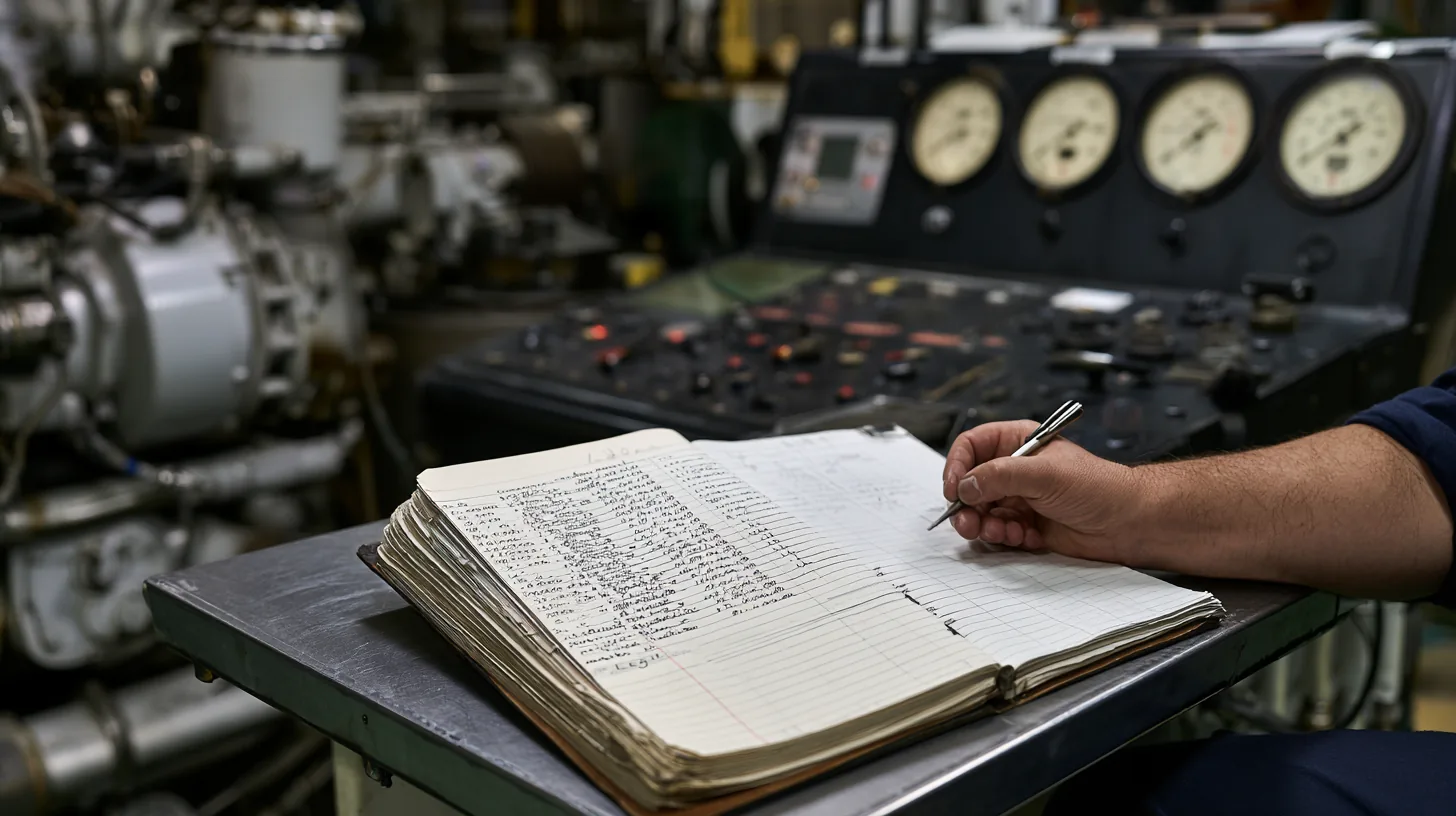
The engine room logbook is where the engine team writes down what it sees and what it does. Temperatures, pressures, running hours, bunkering, safety device tests, breakdowns. On most ships it still exists as a large ledger on the control room desk, filled in by hand by the duty engineer and countersigned every day by the chief engineer.
That ledger is often the only continuous evidence that the machinery has been watched, run and maintained the way the safety management system says it should be. Kept well, it defuses half an inspector's questions. Kept badly, it creates them. And it is routinely confused with documents that have nothing to do with it: the deck logbook on one side, the statutory pollution record books on the other.
This article is about the engine logbook and nothing else: what goes in it, what it does not replace, what auditors and surveyors do with it, and what moving it off paper genuinely changes.
Engine logbook and deck logbook: two documents, two sets of hands
The deck logbook records the conduct of the ship: course, speed, position, manoeuvres, weather, watch handovers, navigational events. Deck officers keep it under the master's authority. It is a different document, written by different people, under a different regime. If that is the one you are dealing with, our complete guide to the ship's logbook covers it in detail.
The engine room logbook records something else: the condition and the operation of the machinery. Watchkeeping engineers keep it under the chief engineer's authority. It does not say where the ship is going, it says how her machinery is behaving while she gets there.
Who writes, who countersigns
The practice is consistent from ship to ship, whatever the size of the engine team. The duty engineer fills in and signs the page for his own watch. The chief engineer countersigns daily, and that countersignature is the verification step. On a ship with an unattended machinery space, rounds and parameter readings replace the continuous watch, but the principle does not change: whoever took the reading signs, whoever is accountable countersigns.
That double signature is what gives the document its weight. An unsigned reading commits nobody. A signed reading commits a named officer, at a stated time, to a stated value. That is exactly what an investigator or a surveyor will be looking for three months later.
A ship's document, not a convention record book
Unlike the Oil Record Book, the engine logbook does not come from a single international convention that fixes its format. It sits with flag State regulation, classification society requirements, and above all with the company's safety management system. Chapter 10 of the ISM Code requires the company to establish procedures to ensure the ship is maintained in conformity with the applicable rules, that inspections are held at appropriate intervals, that any non-conformity is reported with its possible cause, that appropriate corrective action is taken, and that records of these activities are maintained. In practice, the engine logbook is one of those records.
The practical consequence is that its exact content varies from one company to the next, and the safety management manual is what governs on board. Before arguing about the medium, paper or digital, you need to know what your own procedure requires to be in it.
What goes in it, watch after watch
The content splits in two: periodic readings, taken at fixed intervals, and events, recorded when they happen. Both are needed. The readings give the trend, the events give the explanation.
The watch readings
These are the values taken every watch, or on every round, on the machinery in service. They are only worth anything because they repeat: a single value says nothing, a series says everything.
| Item | What is read | What the series reveals |
|---|---|---|
| Main engine | Revolutions, load, exhaust temperature per unit, lube oil pressure and temperature, jacket water in and out, scavenge air pressure and temperature | Imbalance between units, turbocharger fouling, a cooler losing performance |
| Auxiliary generators | Running hours, load in kW, exhaust temperatures, oil pressure, water temperature, voltage and frequency | How load is really shared between sets, uneven wear, a set permanently underloaded |
| Fuel systems | Differential pressure across filters, preheating temperatures, viscosity at the viscometer, purifier throughput and temperature | Progressive clogging, drift in fuel treatment |
| Water and oil systems | Pressures and temperatures either side of the coolers, tank levels, top-ups made | Fouled tube stacks, slow leaks, abnormal oil consumption |
| Compressed air | Starting air bottle pressure, compressor running hours, delivery temperatures | A leak on the starting air line, a compressor running far too often |
| Ship's service auxiliaries | Condition of bilge, ballast and general service pumps, purifier operation, steering gear tests | Machines that are never tried, a standby unit left idle |
| Bunkers and tanks | Soundings, service tank temperatures, consumption since the previous reading | The gap between calculated and measured consumption |
These lines are not a tick-box exercise. They are the raw material for every later argument about the state of the machinery, including on the days when nobody noticed anything at the time.
The operating events
Alongside the readings, the engine log records everything that falls outside the routine of the watch:
- Starting and stopping main and auxiliary machinery, with the exact time and the reason.
- Turning the main engine, tests before manoeuvring, steering gear tests.
- Testing of safety devices and alarms: emergency stops, engine room fire detection, bilge high level alarm, low lube oil pressure trips, overspeed devices. Chapter 10.3 of the ISM Code asks the company to identify equipment whose sudden operational failure may result in a hazardous situation, and to test standby arrangements and equipment that are not in continuous use on a regular basis. The engine logbook is where that test leaves its trace.
- Bunkering: date, start and finish times, quantity, tanks involved, density and temperature, sample taken.
- Internal transfers of fuel and oil between tanks, draining of service tanks and settling tanks.
- Samples drawn for lube oil analysis, with the bottle reference and the time of sampling, engine hot.
- Breakdowns, defects, alarms triggered, action taken and return to service.
- Repairs done by the crew, parts removed and fitted, settings changed.
- Outside attendance: maker's technician, workshop, class surveyor, diver, with name, company and purpose of the visit.
One point of form with real consequences: an event is written down at the time it happens, not at the end of the watch and not from memory. The value of the document depends on how close the record is to the fact.
The statutory record books the engine log does not replace
This is the most common confusion, and the most expensive one during an inspection. The engine logbook is an operating document. It substitutes for none of the record books required by international conventions, each of which has its own format, its own signatory and its own retention period.
The Oil Record Book
Oil Record Book Part I, covering machinery space operations, is required by regulation 17 of MARPOL Annex I. It applies to every oil tanker of 150 gross tonnage and above and every other ship of 400 gross tonnage and above. Operations are entered under coded headings, A to I: ballasting or cleaning of oil fuel tanks, discharge of dirty ballast or cleaning water from those tanks, collection and disposal of oil residues, non-automatic discharge or transfer of bilge water, automatic discharge or transfer, condition of the oil filtering equipment, accidental or exceptional discharges, bunkering of fuel or lubricating oil, and additional operational procedures and remarks.
Each completed operation is signed and dated by the officer in charge. The master signs each completed page. The book is kept for three years after the last entry. Part II, covering cargo and ballast operations, applies to oil tankers only.
The point to hold on to: a bunkering is written twice, once in the engine log for operational purposes and once in the Oil Record Book for MARPOL compliance. The two entries must tell the same story. A discrepancy in quantity or timing between the two documents is exactly what an inspector will work on.
The Garbage Record Book
The Garbage Record Book comes from regulation 10 of MARPOL Annex V. It applies to ships of 100 gross tonnage and above, ships certified to carry fifteen persons or more, and fixed or floating platforms. Discharges and incinerations are recorded with the date, time, position, description and estimated quantity. It is kept for two years after the last entry. The garbage management plan follows the same thresholds.
The Ballast Water Record Book
Where applicable, that is on ships subject to the BWM Convention, a Ballast Water Record Book is kept under regulation B-2. It records ballasting, deballasting, treatment and discharge operations. Resolution MEPC.383(81), which applies from 1 October 2025, amended regulations A-1 and B-2 to frame the use of an electronic record book in place of the hard copy.
| Document | Who writes it | What it contains | Basis and retention |
|---|---|---|---|
| Deck logbook | Deck officers, under the master's authority | Conduct of the ship, navigation, manoeuvres, events | Flag State regulation |
| Engine room logbook | Watchkeeping engineers, countersigned by the chief engineer | Watch readings, machinery operation, tests, bunkering, breakdowns, repairs | Flag, class, safety management system |
| Oil Record Book Part I | Officer in charge of the operation; master on each completed page | Oil operations in machinery spaces, headings A to I | MARPOL Annex I regulation 17, three years after the last entry |
| Garbage Record Book | Officer in charge of the operation | Discharges and incinerations: date, time, position, estimated quantity | MARPOL Annex V regulation 10, two years after the last entry |
| Ballast Water Record Book | Officer in charge of the operation | Ballasting, deballasting, treatment, discharge | BWM Convention, regulation B-2 |
These documents are not interchangeable, but they are checked together. An inspection that starts with the Oil Record Book almost always continues into the engine log, because that is where the purifier running hours, the filter differential pressures and the soundings that ought to corroborate the MARPOL entries are found.
What the engine log decides at audit and inspection
Four different people look at this document, with four different questions.
The ISM auditor
He is not looking for a breakdown, he is looking for a system. His question is straightforward: is what your manual says the same as what you actually do? He opens the engine log to check that the periodic tests set out in the procedure really took place at the stated intervals, that the anomalies recorded led to an action, and that the action is traceable. A monthly test that cannot be found for four months is a non-conformity, even if the machine never failed.
The Port State Control inspector
He works fast and looks for inconsistencies. He cross-checks three things: the Oil Record Book entries, the engine log readings, and the physical state of the machinery in front of him. A bilge separator whose running hours never move while the ship is trading, an oil content meter alarm logged as tested but with the sensor disconnected, a visible repair on a pipe with no written trace anywhere: those contradictions are what turn a visit into a deficiency, and a deficiency into a detention. Our article on how to avoid a Port State Control detention sets out that mechanism in detail.
The classification surveyor
On survey, he verifies that the machinery under his scope has been operated and maintained under the expected conditions. Cumulative running hours drive machinery survey due dates and govern any postponement. On a ship holding an approved planned maintenance system, the surveyor compares the approved programme with what was actually carried out, and the logged hours are the common reference. An hour counter that was never recorded, or recorded with unexplained jumps, undermines the basis of the whole arrangement.
The underwriter, after damage
After a failure, the question becomes: was the machine operated within its limits and maintained as prescribed? The engine log is the first document the average adjuster or surveyor asks for, alongside the oil analysis reports. A series of exhaust temperatures within tolerance, stable oil pressures and safety tests up to date support the case for a hidden defect or a faulty component. Missing readings in the weeks before the failure, or values that are plainly copied, support the opposite case.
| Check | What it asks for | Where it is found |
|---|---|---|
| Internal or external ISM audit | Evidence that planned tests and inspections took place and that anomalies were dealt with | Engine log, closed work orders, non-conformity reports |
| Port State Control | Consistency between statutory record books, engine readings and observed condition | Oil Record Book, engine log, purifier and compressor running hours |
| Classification survey | Cumulative running hours, execution of the maintenance programme, safety device tests | Hour counters, engine log, planned maintenance system history |
| Insurance survey after damage | Operating parameters before the event, maintenance carried out, warnings acted on or ignored | Engine log reading series, oil analyses, job history |
| Internal technical investigation | Precise chronology, who had the watch, what action was taken | Time-stamped and signed engine log |
Where the paper engine log fails
The ledger is not bad by nature. It fails predictably, always in the same places.
Illegible handwriting. A 3 that reads as an 8, a decimal point rubbed out, a column out of line. The reading exists but cannot be used, which amounts to the same thing when a surveyor is hunting for one figure two years later.
Copied readings. This is the worst failure, because it destroys the value of the document without leaving any visible trace. Exhaust temperatures identical to the degree across twelve consecutive watches do not prove the machine is stable, they prove the previous line was copied. An inspector spots that pattern immediately, and draws a general conclusion about how the machinery is being run.
Gaps. They appear exactly when the document would have been most useful: during a busy port call, during a breakdown, during a docking, during a crew change. The watch was kept, but nobody had time to write.
The book that stays on board. The superintendent ashore needs a series of values to prepare an order or settle an argument about a repair. The book is on board and the ship is at sea. Either you wait for the next port, or you ask for photographs of pages by email, which produces a fragmented history nobody can consolidate.
Delayed entry. Values are scribbled on a scrap of paper at the machine and transferred at the end of the watch, sometimes from memory. Every transfer is a chance to make a mistake, and the precision of the time stamp is lost.
What a digital engine logbook actually changes
Going digital is only worth it if it deals with those five failures. On the following points, it does.
Entry at the machine, including offline
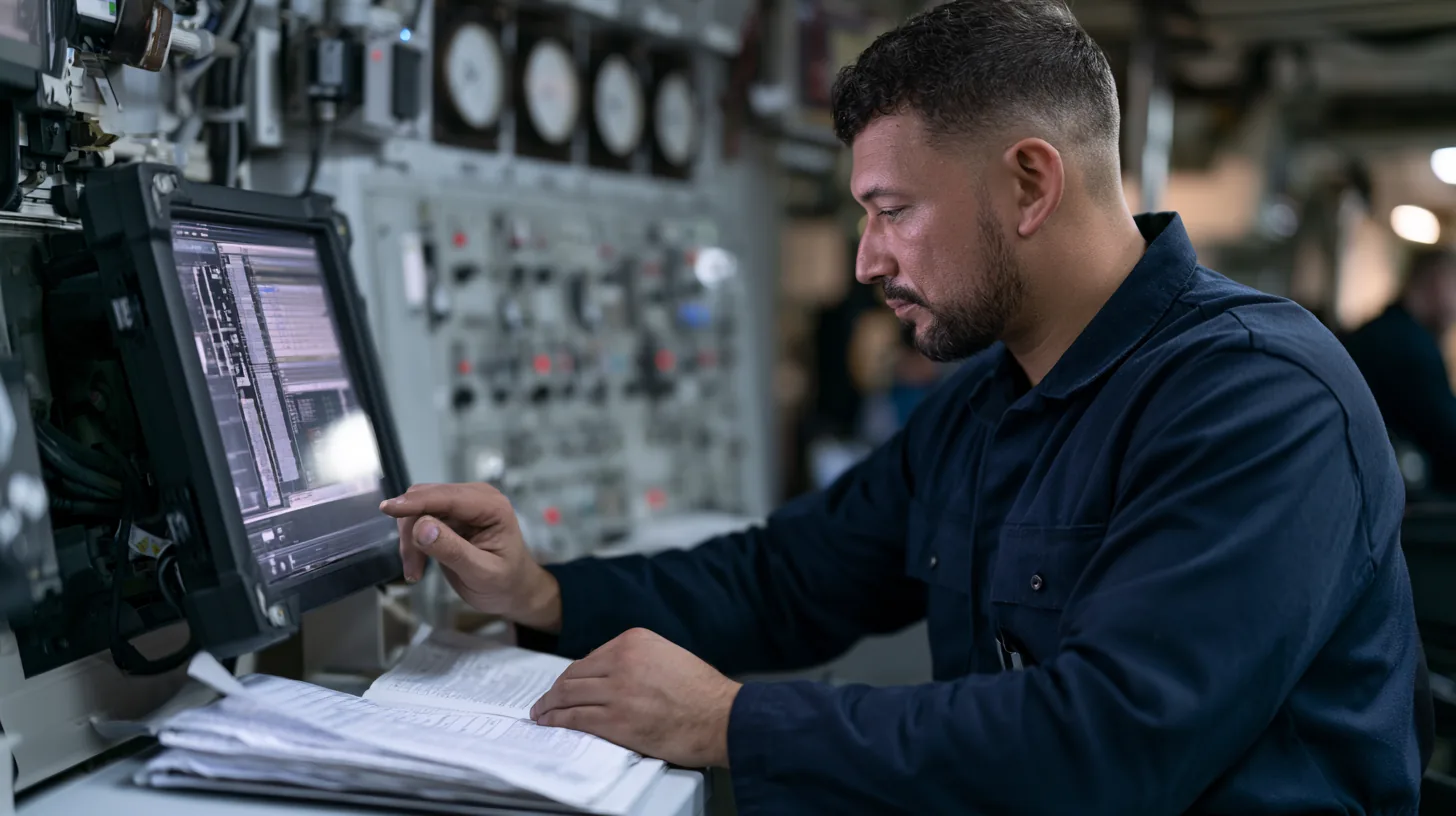
The reading is taken on a tablet or a rugged phone, in front of the unit, at the moment the gauge is read. No transfer, no memory. In a machinery space, network coverage is poor or absent: entry has to work offline and synchronise later. That is a condition of adoption, not a convenience.
There is a second, less obvious effect: entry limits. When a value falls outside the expected range for that machine, the tool flags it as it is typed. The engineer checks straight away whether he misread the gauge or whether the machine is genuinely drifting, instead of discovering the anomaly when someone reads back the ledger three weeks later.
Hour counters picked up automatically
Running hours are the figure that triggers everything: maintenance due dates, spare part ordering, specific consumption calculations, class survey intervals. They are also the figure most often forgotten. When counter tracking feeds the maintenance plan directly, a due date is no longer missed because a number was not copied onto the wall chart.
From an abnormal reading to a job
In a ledger, an abnormal reading stays an abnormal reading. Somebody has to read it, remember it and raise a job request. In a digital system, an out-of-range value creates the observation directly, then the work order, attached to the equipment concerned. The human link between finding and action disappears, and that link is precisely the one that breaks in practice.
Comparing sister ships, and reading from ashore
Two identical ships on the same trade ought to produce comparable series. When they do not, the gap is a signal: different settings, different fuel quality, a fouled tube stack, or simply a different way of running the plant from one team to the next. That comparison is impossible with two ledgers sitting in two separate control rooms. It becomes immediate when readings land in a common reference.
The same logic applies ashore. The superintendent reads today's figures without waiting for the next port, prepares the spare part order before arrival, and settles a repair question with the values in front of him. And when an audit is coming, the file is built by extraction rather than by photocopy: the history of one item over the requested period, safety tests carried out, bunkerings, jobs done. It is a matter of minutes, not evenings.
The link with fuel monitoring
Soundings, consumption per machine and running hours taken at each watch are the foundation of any credible fuel consumption monitoring. Without reliable, time-stamped readings, a specific consumption figure is an average with no diagnostic value. With them, a gap between calculated and measured consumption becomes a line of enquiry.
What makes an electronic record stand up
A digital record has no value in itself. It has value if you can establish who entered what, and when, and demonstrate that nothing has been quietly changed since.
What is needed technically
- Named accounts. A shared engine room login destroys the chain of accountability. Every officer enters under his own account.
- Reliable time stamping, distinguishing the time of the reading from the time of entry when the two differ, and handling time zones and ship's time changes explicitly.
- An immutable history. Correction stays possible, and it should, but a correction is added to the file rather than overwriting the original: old value, new value, author, time, reason.
- No silent deletion. A deleted line must remain visible as deleted. It is the first thing a surveyor will check if he suspects a record was tidied up after the event.
- A readable, complete export, in PDF or spreadsheet form, usable by somebody with no access to the software: an inspector, an average adjuster, a court.
- Retention consistent with the periods applicable to the documents the engine log is used to corroborate.
Electronic in place of paper: it depends on the flag
Two separate questions have to be kept apart here.
For the statutory MARPOL record books, the framework exists. The guidelines adopted by resolution MEPC.312(74), together with the amendments to Annexes I, II and V by resolution MEPC.314(74) and to Annex VI by resolution MEPC.316(74), have since 1 October 2020 allowed the Oil Record Book, the Cargo Record Book, the Garbage Record Book and several Annex VI records to be kept electronically. The option is not automatic: the electronic record book must be approved by the flag State or by a recognised organisation acting on its behalf, and a declaration confirming that approval must be carried on board and produced at inspection. The same approval and declaration mechanism applies to the electronic Ballast Water Record Book from 1 October 2025.
For the engine room logbook itself the position is different, and it has to be stated conditionally: because it does not follow a single convention format, its acceptance in electronic form would rest with the flag State and, where relevant, with the classification society. Some administrations would accept a log kept electronically, others would still require a signed printed version, others some combination of the two. There is no general answer valid for every flag, and any claim to the contrary should be verified before it is relied on.
The prudent course is therefore this: write to the flag administration and to the classification society before you retire the ledger, get the answer in writing, and keep it with the safety management documentation. Until that answer is in hand, treat the digital system as the working tool and keep the medium the flag accepts as the official document.
Running the machinery on the readings
This is the most profitable use of the engine log, and the one most often neglected. A series of readings is not an archive: it is an instrument for measuring drift.
One value says nothing, a slope says everything
A single cylinder exhaust temperature taken on its own means very little. The same value, when the other units are thirty degrees lower and it was itself twenty-five degrees lower six weeks ago, means a great deal: injector, valve clearance, turbocharger fouling or badly shared load. The information is carried by the spread between units and by the slope over time, not by the raw figure.
The same reasoning applies to filter differential pressure. The alarm setting tells you to act now. The slope tells you when you will have to act, which lets you plan the cleaning for a convenient period rather than in the middle of a manoeuvre.
| What is read | Drift signal | Decision it supports |
|---|---|---|
| Exhaust temperature per unit | Growing spread between one unit and the average of the others | Check injector and clearances ahead of the calendar interval |
| Filter differential pressure | Steady slope towards the alarm setting | Cleaning or replacement planned for a convenient window |
| Temperatures either side of a heat exchanger | Temperature difference narrowing at the same load | Tube stack cleaning, check the sea water side |
| Lube oil consumption | More frequent top-ups at constant operation | Leak search, sample drawn for analysis |
| Scavenge air pressure at a given load | Progressive fall over several weeks | Turbocharger inspection and cleaning |
| Bearing temperature | Slow rise across several consecutive readings | Check alignment, bearing condition and lubrication |
From calendar to condition
These signals are the way into condition-based maintenance. A job triggered every X hours is easy to plan but blind to actual condition: it comes too early on a healthy machine and too late on a hard-worked one. A job triggered by a measured criterion follows the machine.
Watch readings are the base layer of that arrangement, the cheapest and the densest. They are naturally completed by fluid analysis, which sees wear before it shows up as temperature, and by vibration analysis and thermography, which locate the mechanical or electrical fault. None of those techniques replaces the watch reading. All of them rely on it to tell an unusual value from a value that is normal for that particular machine.
Moving from paper to digital without breaking anything
A botched changeover produces something worse than the ledger: partial entry, doubled by a ledger still kept in parallel just in case, and therefore two incomplete histories.
How much history to carry over
Do not carry over ten years of ledgers. The useful transfer is three things: current hour counters for every machine you intend to track, the dates of the last major overhauls with the corresponding hours, and the significant failures of recent years with their cause. The rest of the ledgers are archived physically and remain available for consultation without being keyed in.
Carrying over the counters is the critical step. A wrong figure at the start distorts every due date calculated afterwards. It is done machine by machine, read physically, countersigned by the chief engineer, on a stated date that becomes the zero point.
Getting the engine team to use it
An engine team adopts a tool that gives time back and rejects one that takes time away. Three principles hold up in service.
First: entry has to be faster than the pen. If a watch reading takes longer on a tablet than in the ledger, the tool will be worked around. Short forms, fields in the same order as the round, previous values visible, units pre-filled.
Second: the feedback has to be immediate. If an officer enters data for six months and never sees anything come back, he is entering data for the office. If he sees his own trend, sees that his report created a work order, sees that the superintendent replied, he is entering data for the machine.
Third: the chief engineer has to countersign inside the tool, not somewhere else. As long as verification stays on paper, the tool is seen as a duplicate. Moving the signature is what makes the change of medium real.
The part played by the crew change
The crew change is where a changeover is won or lost. It is the moment unwritten knowledge is lost, and it is where a digital tool proves its worth: the relieving officer reads what the outgoing officer actually observed, with the values, instead of relying on a twenty-minute verbal handover at the gangway.
Two simple measures. Time the go-live with a crew change, so that a complete team starts on the new tool rather than switching method halfway through a tour. And build a machine-by-machine handover note into the handover pack: what is under watch, what has drifted, what is waiting for a part. That note writes itself if readings and observations are entered as they occur.
Never run two logs in parallel
The temptation to keep the ledger going for six months, just in case, is strong. It is the surest way to end up with two incomplete and contradictory documents, which no auditor forgives. Set one changeover date, announce it to the ship and to the office, and hold it. If the flag requires an official paper record to be kept, produce it as a signed printout from the digital system, not by keying everything in twice.
The document that proves the machinery was run properly
The engine room logbook is not paperwork. It is the only continuous evidence that a machine was watched by named people, at stated times, against recorded values. An ISM auditor, a Port State Control inspector, a class surveyor and an insurance surveyor are all looking for the same thing from four different angles: consistency between what was planned, what was done and what is observed.
Going digital does not make the document virtuous by itself. It removes the failures of the medium: the illegible, the copied, the gap, the ledger stuck on board, the entry made from memory. And it adds what paper never managed: turning a series of readings into a drift signal, and a drift signal into a planned job.
The condition is to treat the question of the medium for what it is, a regulatory question to settle with your flag and your classification society, and not simply a tooling decision. Ask them before you close the ledger, keep the answer in writing, and build the rest on top of it.
For the bridge we also provide a printable ship logbook template. The engine room log itself is one piece of the vessel's technical file, whose contents our maritime CMMS guide lists.


