
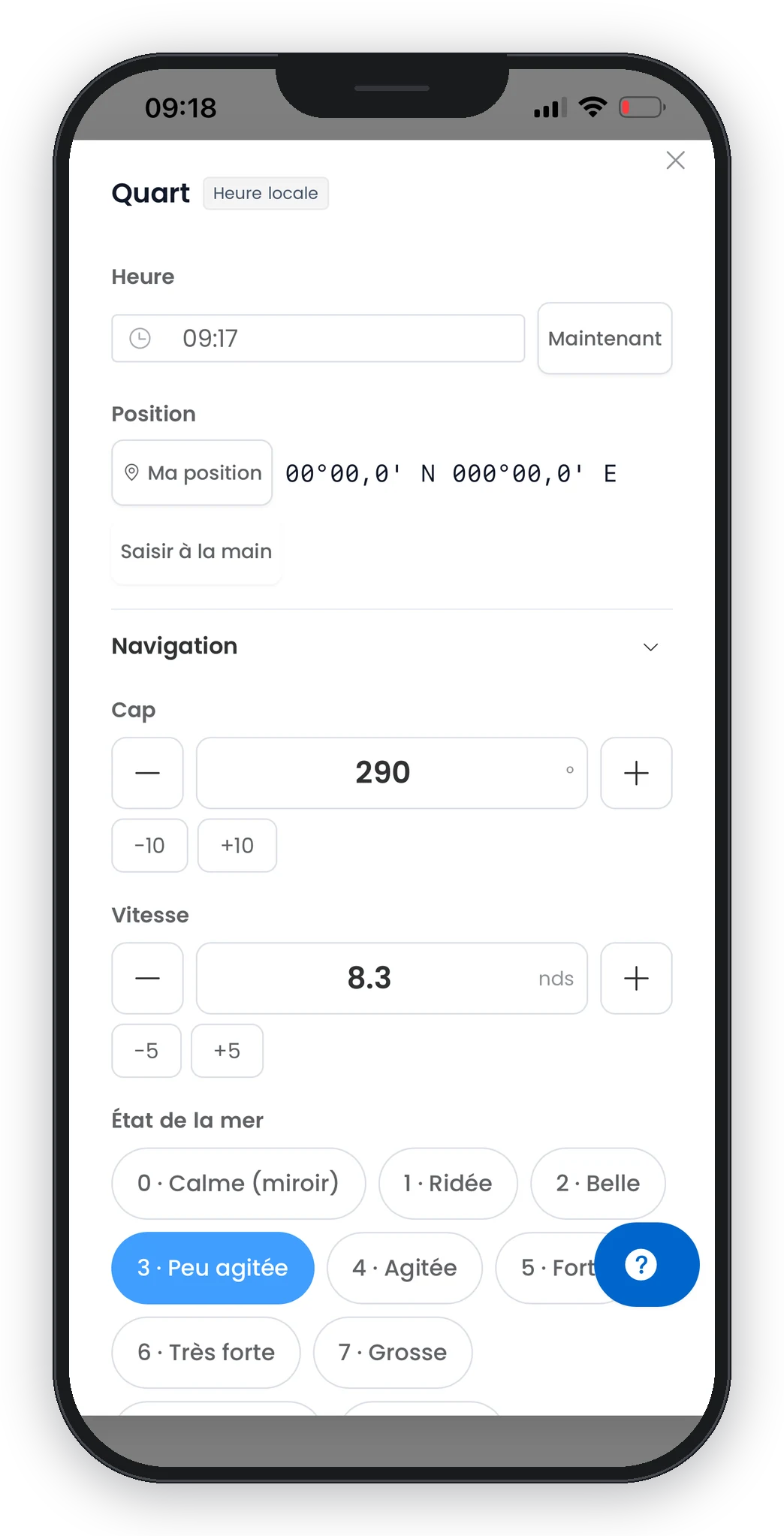
A watch entry takes under ten seconds, one-handed, with gloves on, on a wet screen, with no signal. And unlike the bridge notebook, it feeds your maintenance and can be proven.
The logbook is the last register still kept on paper on board. It is also the one you will be asked to produce the day something is disputed.
A single notebook is a single point of failure. Soaked, lost, or simply left on the boat, it takes the whole history with it. An entry that syncs ashore removes that risk.
The engine hours read during the watch end up in a text column, then in a spreadsheet, when someone remembers. Entered in the logbook, they become a genuine maintenance reading and recalculate the due dates on their own.
A spreadsheet can be edited without leaving a trace, which is exactly what disqualifies it in a dispute. Immutable, time-stamped entries give the document a credibility paper alone does not have.
Four things the bridge notebook will never do.
A one-tap “Nothing to report” button for a quiet watch, or the detailed entry with collapsed blocks. Numbers are set with large plus and minus buttons, never the keyboard.
Everything is entered without a signal. The time kept is the time of your entry, not the time of the sync: a line written at 03:15 offshore stays dated 03:15.
The counter entered during the watch is a genuine maintenance reading: it recalculates due dates and triggers the tasks, with no double entry.
The fleet list shows, for each vessel, its last entry. A logbook with no entry for more than three days turns red.
This module is part of the 91Â鶹¾«Ʒ platform, the maritime CMMS that brings all twelve modules together in a single subscription.
Discover 91Â鶹¾«Ʒ maritime CMMS software →A logbook is only worth the trust placed in it. A spreadsheet can be edited, a notebook rewritten.
No edits, no deletions after validation — server side included. A mistake is corrected by an amendment that references the original line and leaves it visible, like the countersigned strike-through in a paper register.
Every entry receives a SHA-256 fingerprint computed from its content and from the previous entry's fingerprint. Altering an old line would break the fingerprint of every line after it.
Time of the event, time of entry, time received by the server. That is what separates an entry made on the spot from an evening reconstruction.
Numbers are assigned by the server and never reused. An automatic check verifies none is missing: a line deleted from the database would leave a visible gap.
Signing a page freezes the line numbers it covers and records a fingerprint of their exact content. You are not signing a date: you are signing those lines, in that state.
This set-up forms a solid body of technical evidence, presentable to an insurer, an ISM auditor, an inspection or a court. It is not, however, an administratively approved register, and 91Â鶹¾«Ʒ does not replace a document your flag requires in a particular form. The notice appears at the foot of your PDF exports.
Keeping the logbook and signing its pages are two separate permissions. The person writing during the watch is not necessarily the one who closes and signs the day — the same split as the paper register, where the watch writes and the master signs. Reading remains open to any user with access to the vessel, with nothing to configure.