

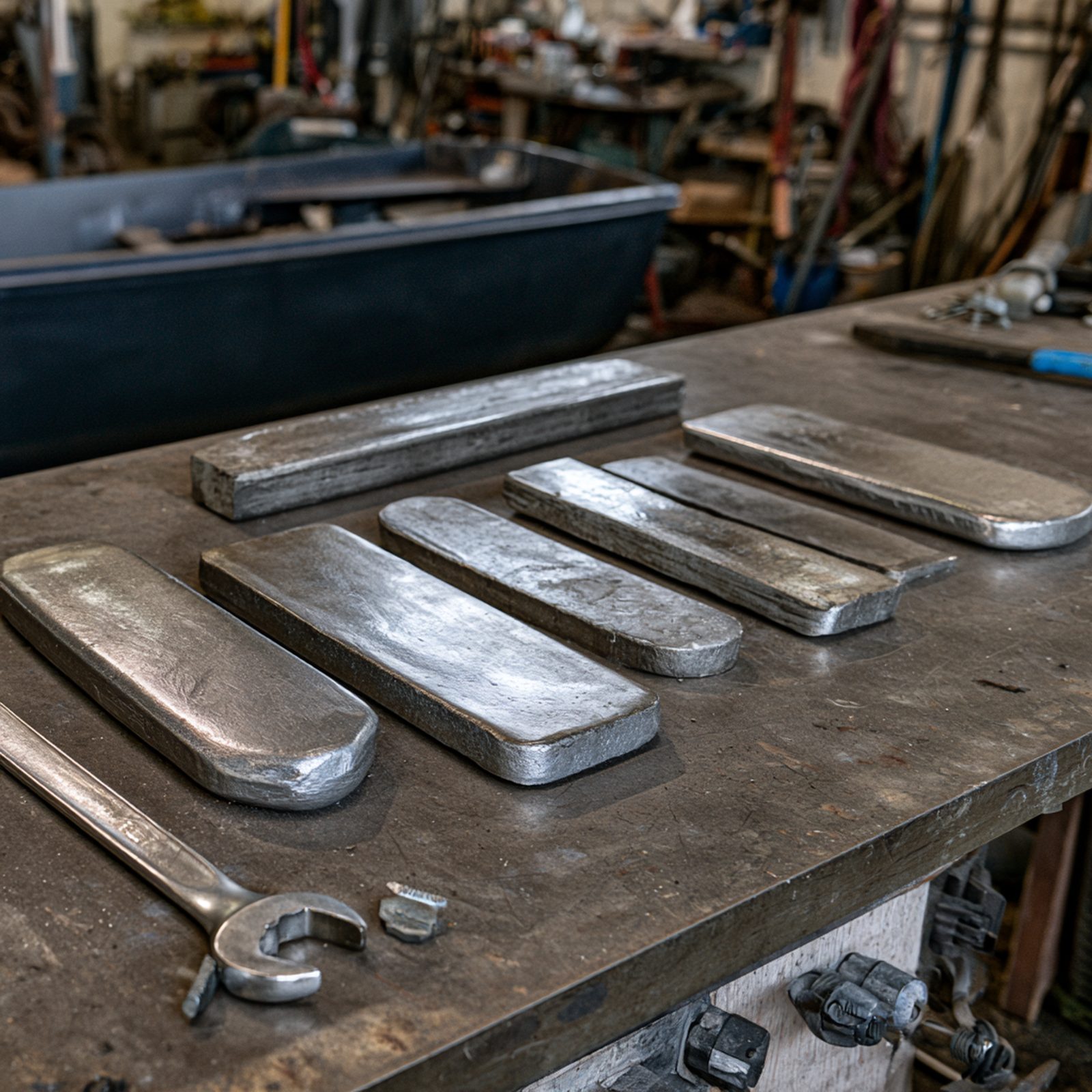


A sacrificial anode is not an accessory. It is a consumable whose only job is to disappear instead of the propeller, the shaft, the rudder and the skin fittings. If it does not waste, it is protecting nothing. If it vanishes in three months, the anode is not the problem 鈥� something else on the vessel is.
This guide explains the phenomenon the anode is fighting, how the alloy is chosen according to the water, where to look for anodes on a vessel, how to read wastage, and which mistakes cancel the protection out completely. It is written for the experienced owner, the skipper and the professional seafarer who wants to understand what is being bolted on below the waterline rather than copying a catalogue reference.
Galvanic corrosion: the battery that forms under the waterline
Two metals, an electrolyte, a bond
Immerse two dissimilar metals in seawater and connect them electrically: you have just built a battery. The seawater acts as the electrolyte, the metallic bond as the conductor. A current flows, and the less noble of the two metals dissolves 鈥� it literally goes into solution 鈥� while the other stays intact.
On a vessel that electrical bond nearly always exists, even when nobody intended it. The propeller shaft touches the gearbox, which touches the engine, which is tied to the bonding system, which reaches the ship's electrical installation. The bronze of the propeller, the stainless of the shaft, the cast iron of the block, the brass of a seacock and the steel of the hull all form one single circuit. The sea closes the loop.
This is not laboratory theory. It is what explains a brass skin fitting that has gone pink and crumbly, a bronze propeller pitted along the trailing edges, or an aluminium sterndrive eaten away around its stainless fastenings.
The galvanic series, in practical terms
The galvanic series ranks metals and alloys by their potential in seawater, measured against a reference electrode. At the top sit the noble metals: titanium, passivated stainless, copper alloys. At the bottom sit the active ones: mild steel, aluminium, zinc, magnesium.
The rule fits in one sentence: in any couple, the more active metal is the one that gets sacrificed. The wider the potential gap between the two, the faster the corrosion. Stainless and titanium live together without drama. Aluminium and bronze, in the same water and electrically connected, are a bad marriage.
That is exactly what an anode exploits. You deliberately introduce into the circuit a metal more active than everything else on board. It becomes the designated weak point and is consumed instead of the parts you want to keep. Cathodic protection does not abolish corrosion; it chooses the victim.
The trap of stainless starved of oxygen
Stainless steel only resists corrosion thanks to an oxide film that reforms continuously in contact with dissolved oxygen. Shut away from oxygen 鈥� under a badly fitted shaft collar, inside a stern gland, beneath a thick layer of fouling 鈥� it loses that passivation and becomes far more active than it looks. This is where the crevice corrosion comes from that you discover on stripping a shaft that appeared perfectly sound from the outside. An anode does not compensate for that: it protects what it can reach electrically and chemically, not what is sealed away.
What a sacrificial anode actually does
Four elements, and if one is missing nothing works
- The anode: the active metal you accept losing.
- The cathode: everything you want to protect 鈥� propeller, shaft, rudder, hull, valves, heat exchanger tube stack.
- The electrolyte: the water the vessel floats in. Out of the water nothing happens at all; a vessel ashore does not consume its anodes.
- The metallic bond: the electrical path between the anode and the part being protected. This is the link most often neglected.
That bond deserves a moment. An anode bolted to a painted plate, a collar clamped on a shaft covered in antifouling, a nut so corroded it no longer bites: in all three cases the metal is there, it may even corrode locally on its own account, but no current reaches the part it is supposed to protect. The anode is decorative. A continuity check with an ohmmeter between the anode and the protected part should read very low, close to zero.
An anode that does not waste is not protecting anything
This is the most useful mental reversal to make. You do not buy an anode so that it lasts; you buy it so that it is consumed at a sensible rate. Steady, moderate wastage between two haul-outs is the sign of a system doing its job. An anode that comes out of the water untouched after a full season is a warning, not good news: it means the hull, the shaft and the propeller have been fending for themselves the whole time.
Zinc, aluminium, magnesium: the water decides
Three families of alloy cover every requirement. Neither the type of vessel nor the budget makes the decision 鈥� the salinity of the water the vessel spends most of its time in does. An alloy in the wrong environment is not merely less effective: it either stops protecting altogether, or dissolves within days.
| Alloy | Suited to | Typical applications | Watch out for |
|---|---|---|---|
| Zinc | Seawater | Steel hulls, shafting, bronze propellers, rudders, hull plates, heat exchanger pencils | Passivates in brackish and fresh water: it skins over with an insulating white crust and stops delivering current |
| Aluminium | Seawater and brackish water | The same applications as zinc, plus aluminium hulls, sterndrives and thrusters | Stays active where zinc passivates; for the same mass it delivers more protective capacity |
| Magnesium | Fresh water | Submerged parts in lakes, rivers and canals; calorifier anodes | Consumed very fast in seawater; risk of over-protection on aluminium hulls, with paint blistering |
Zinc
Zinc is the historic seawater alloy and it remains entirely valid for a vessel that never leaves salt water. Availability is universal, every shape exists in the catalogue, and propeller, gearbox and sterndrive manufacturers specify it as original equipment. Its weakness is clear: in brackish or fresh water it passivates. The oxide crust that forms on its surface insulates it from the electrolyte and the protective current collapses. A zinc anode in an estuary berth or a canal has effectively stopped working.
Aluminium
This is the most versatile choice today. Indium-activated aluminium anode alloys stay active in seawater and brackish water alike and do not passivate in mixed waters. They suit vessels that work their way up estuaries, winter in a river, or move between basins. It is also the only family worth recommending on an aluminium hull, sterndrive or thruster, where zinc raises compatibility questions and magnesium causes over-protection.
Magnesium
Magnesium sits lowest of the three: very active, and therefore very effective where the water conducts poorly, which means fresh water. It is the alloy of lakes, rivers and canals, and of calorifier anodes fed with fresh water. Put it in the sea and it dissolves so fast that it has no practical value, and it can over-protect neighbouring painted surfaces to the point of lifting the coating. For genuinely mixed operation, aluminium is the sensible compromise; magnesium is reserved for vessels that never see salt water.
What to do when the vessel changes environment
A vessel that spends summer at sea and winter in a fresh water basin poses a real question. Two answers stand up: fit aluminium permanently and accept the compromise, or change the exposed anodes when the vessel moves, which can be planned like any other maintenance operation. The worst option is to decide nothing and leave zincs to passivate all winter.

Where the anodes are on a vessel
On a properly equipped vessel the anodes are neither all in one place nor all the same shape. Taking the inventory once, properly, stops one being forgotten for years. That inventory belongs in the equipment register alongside every pump and filter 鈥� which is what the equipment module is for.
Shafting and propeller
The shaft collar, split or solid, clamps directly onto the shaft between the stern tube and the propeller. It protects the shaft and, through the mechanical connection, part of the shafting. The propeller itself often carries a dedicated anode: a cone screwed onto the end of the hub, a washer under the nut, or a pattern specific to folding and controllable pitch propellers. On those, the reference belongs to the maker and cannot be improvised.
Rudder, sterndrive and thrusters
A metal rudder usually carries one or two flat anodes bolted either side. Sterndrives and Z-drives have a full anode set documented by the engine builder: anti-cavitation plate anode, side anodes, sometimes an internal one. Bow and stern thrusters are the perennial oversight: the tunnel, the leg and the thruster propeller have their own anodes, and awkward access means they are easily skipped during a quick haul-out.
Skin fittings, seacocks and seawater circuits
Metal skin fittings, seacocks and strainers form a set of copper alloy components in direct contact with the water. Depending on the build they are covered by the hull anodes, or by local anodes of their own. This is also where selective corrosion of brass shows itself most plainly, with its characteristic pink tinge.
Heat exchangers, coolers and calorifiers
Internal circuits carry their own anodes, often in pencil form, screwed into the body of the seawater heat exchanger, the oil cooler or the charge air cooler. They are invisible from outside, they can only be checked on dismantling, and they are the ones most often forgotten. A spent pencil that is never replaced eventually lets a tube stack perforate, and replacing a tube stack bears no relation, in cost or in downtime, to replacing a part a few centimetres long. The calorifier on the fresh water side has its own anode too, usually magnesium.
Hull plates
On metal hulls, bolted or welded anode plates spread the protection across the underwater body. Their positions are not arbitrary: they follow the yard's cathodic protection layout, with a higher density aft, around the propeller and rudder, where the noble metals are concentrated. Moving a plate because its original position is inconvenient means rewriting that layout without the data behind it.
Reading anode wastage
Estimating what is left
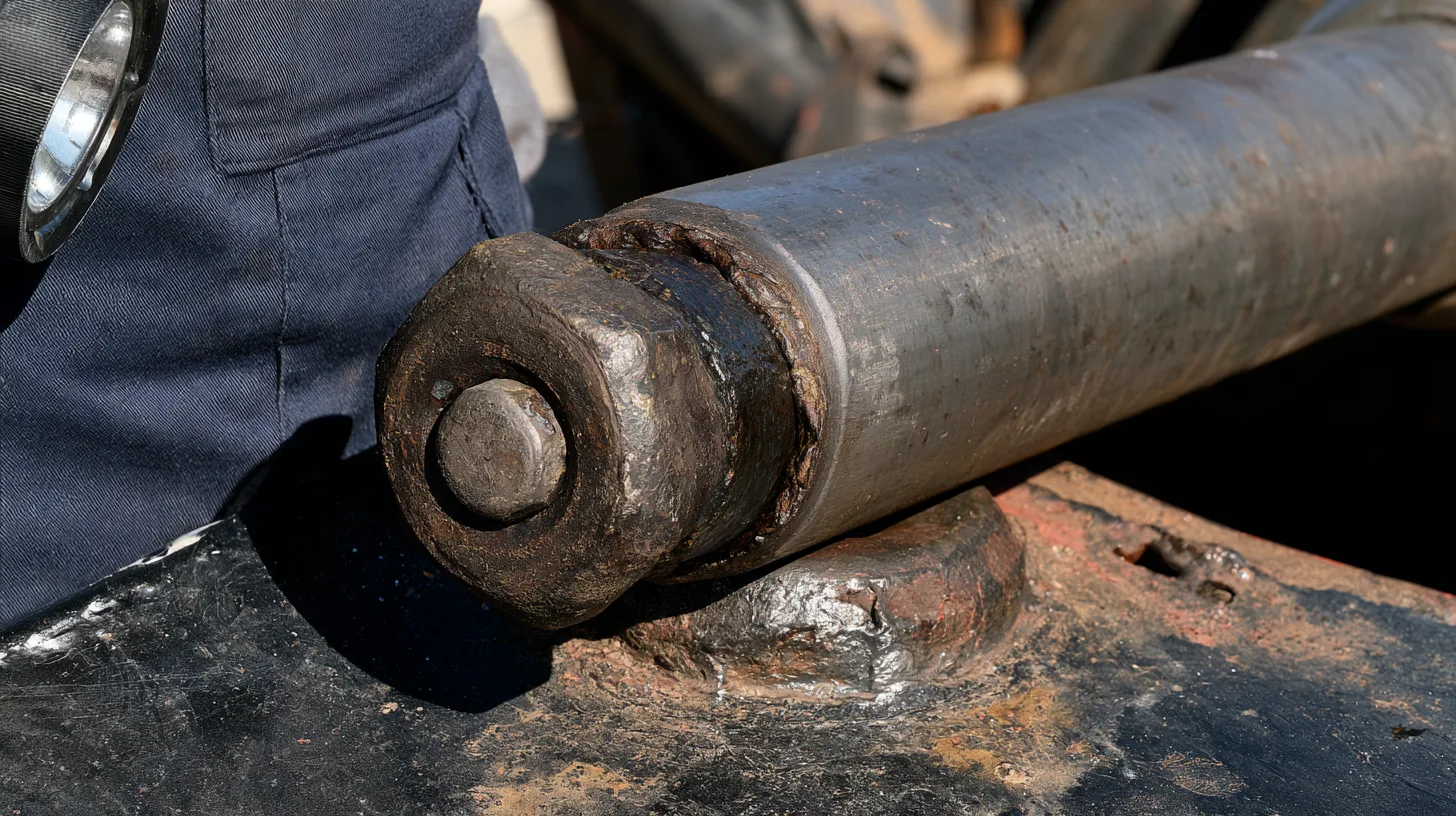
Assessment is done by eye and by hand, in volume and not in surface area. A collar anode whose diameter has halved has lost far more than half its mass. The only reliable reference point is a new anode of the same part number, kept on board in the spares. That is a strong argument for holding a proper anode stock, a subject developed in our article on spare parts management at sea.
Photographing systematically at every haul-out, from the same angle and with something in frame for scale, turns an impression into an observation you can compare year on year. Write the observation into the logbook rather than relying on memory.
What the shape of the wastage tells you
An anode wasted evenly, rounded off, still bright metal under the deposit: the system is working normally. An anode covered in a hard, compact white crust that will not flake away: it has passivated, usually because the alloy does not match the water. An anode hollowed out on one side only: the protection field is unbalanced, or a neighbouring component is draining all the current. An anode that is intact but whose fastenings are eaten away: electrical contact has been lost, the anode is isolated, and the part it was meant to protect has been working unprotected for some time.
Finally, an anode entirely consumed well before its due date deserves an electrical investigation, not simply a like-for-like replacement. Replacing without asking why means paying twice: once for the anodes, then for the component they failed to protect.
The mistakes that cancel out the protection
Painting an anode. The commonest and the most absolute mistake. A coat of antifouling, however thin, insulates the anode from the water and removes all protection. When the underwater body is recoated, anodes are masked or removed; they are never painted over to make things look tidy. The same applies to the contact face on the hull side: it must be taken back to bare metal.
Mixing alloys on the same circuit. Zincs and aluminiums tied to the same bonding system form a galvanic couple between themselves. The aluminium, being more active, is consumed first and protects the zinc instead of the vessel. Keep one alloy for the whole of the external protection, the only exception being internal anodes specified by an engine builder.
Undersizing. An anode too small for the metal surface it has to protect is consumed quickly and lets the protection collapse well before the due date. The classic symptom is a completely spent anode at the next haul-out, together with early pitting on the propeller.
Oversizing. Excess is not harmless either. Too much anode on an aluminium hull or over a fragile coating causes over-protection: hydrogen evolution at the protected surface, coating disbondment and blistering. The correct sizing comes from the yard's or the engine builder's documentation, not from guesswork.
Losing electrical contact. Marine grade stainless fastenings, clean threads, firm tightening without crushing the alloy, a contact face taken back to bare metal: the fitting matters as much as the anode. A continuity check once fitted settles the question in two minutes.
Replacing without recording anything. An anode changed without anyone recording its position, its part number and its condition on removal is information lost. That is precisely what a structured maintenance plan fixes, as set out in our guide to the four-step preventive maintenance plan.
Stray current, shore power and the vessel's electrical system
Two different phenomena
Galvanic corrosion arises from the potential difference between two metals. Stray current is something else: a direct current escaping from one of the vessel's circuits and returning to its source through the water and the structure. An insulation fault on a charger, a bilge pump whose positive lead sits in water, a badly made bonding connection 鈥� the current takes whatever path it finds, and the exit point corrodes.
The practical difference is speed. Galvanic corrosion consumes an anode over a season. Stray current can finish one off in a few weeks and attack bare metal in considerably less. An anode disappearing abnormally fast should therefore lead to an electrical inspection before the next batch is ordered.
Shore power, the galvanic isolator and the isolation transformer
Alongside on shore power, the protective earth conductor ties the vessel's bonding system to the pontoon, and therefore to every other vessel on the same supply. The boat with the most active metals then starts protecting its neighbours. That is the reason galvanic isolators exist 鈥� blocking low DC voltages while preserving the safety function 鈥� and isolation transformers, which separate the two systems outright.
A vessel that spends most of its life alongside on shore power consumes its anodes faster than a comparable vessel that is out working. That factor weighs heavily on the real replacement interval.
What to check on board
Three straightforward checks cover most of it: continuity of the bonding system between the submerged components and the anode connection point, insulation of the DC circuits, and correct operation of the galvanic isolator where one is fitted. On vessels equipped for it, measuring hull potential against a reference electrode gives a direct reading of the protection level without waiting for the next haul-out. These checks are only worth doing if the results are kept and can be compared from one occasion to the next.
From principle to follow-up
Understanding galvanic corrosion and choosing the right alloy solves half the problem. The other half is organisation: knowing how many anodes each vessel carries, exactly where they sit, what condition they were in at the last removal, and when the next one falls due. On one boat, a properly kept notebook does the job. Across a fleet of sisterships worked in different ways, you need something else.
That is the subject of our companion article on anode maintenance and cathodic protection tracking across a fleet: removal threshold, real intervals, the record to keep and how to use the history from several dockings. Time on the blocks is when it all happens, and it has to be prepared: our annual haul-out checklist sets out the full sequence. The technical terms used here are defined in the maritime glossary.
Anode tracking belongs to the vessel's general maintenance plan, whose construction we detail in our maritime CMMS guide.


