

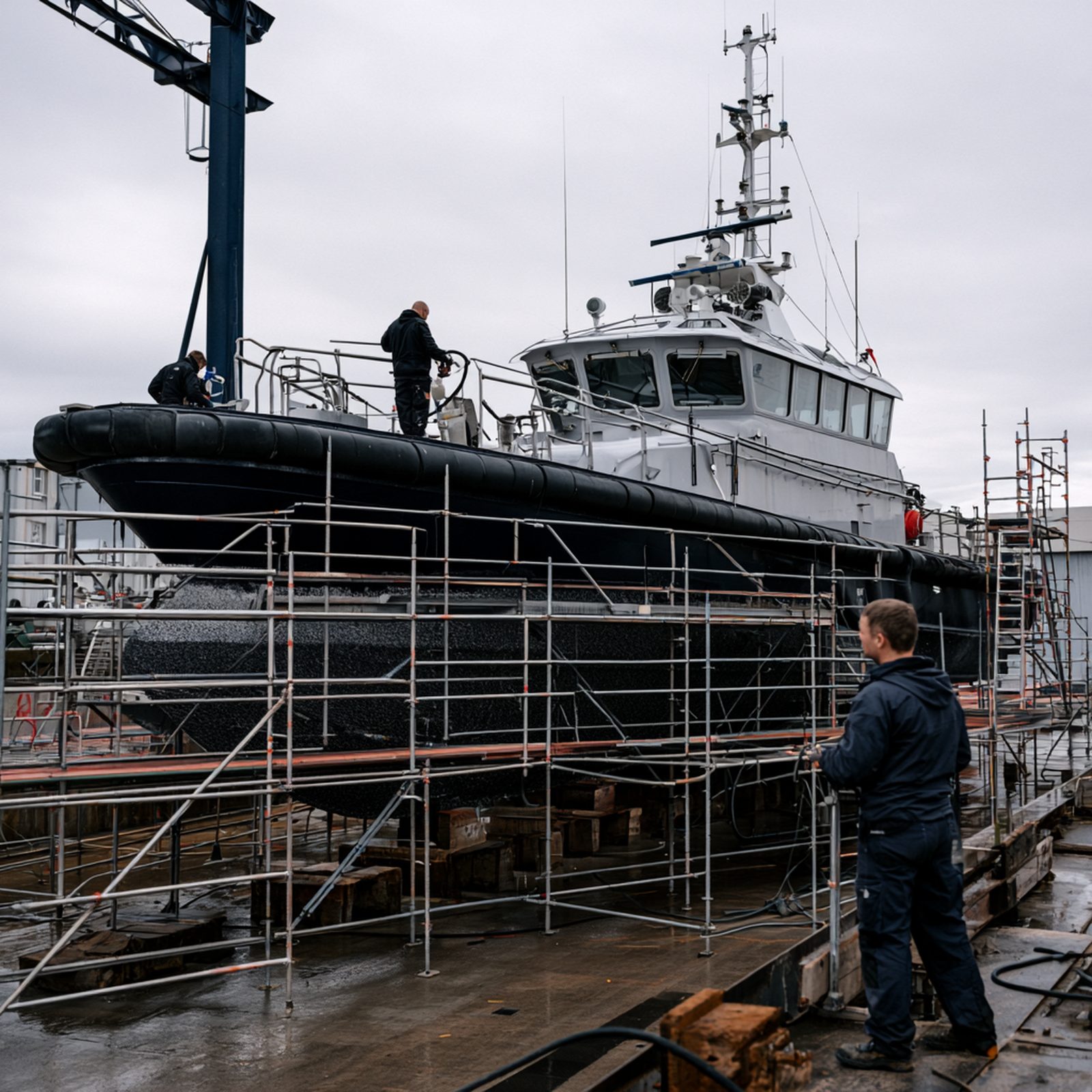


The annual haul-out, a critical operation for the life of your vessel
The annual haul-out is one of the most essential preventive maintenance operations in the calendar. This major intervention 鈥� lifting the vessel out of the water to inspect, clean and treat the whole of the underwater body 鈥� has a direct bearing on the performance, the safety and the working life of the hull. Far beyond a simple hull clean, the haul-out is the ideal moment to catch defects while they are still small, prevent expensive damage, and maintain the compliance your insurer expects.
But how do you turn this complex operation, so often seen as a logistical and financial burden, into an optimised and properly documented process? The answer lies in using a marine CMMS (Computerised Maintenance Management System). Unlike a handwritten task list or a spreadsheet, a CMMS structures the entire haul-out around an automated, traceable digital work order.
The system makes sure the right parts are available at the right moment (stock management for sacrificial anodes and antifouling), documents every step with tangible evidence (before and after photos, recorded measurements, electronic signatures) and builds a complete, auditable maintenance record. In practice, a haul-out properly recorded in a CMMS is a file that holds up against environmental and insurance requirements, while shifting the effort towards preventive maintenance rather than repairs you did not choose.
Preparation and planning: the automatic work order
Automatic triggering and resource allocation
One of the main advantages of applying a CMMS to the haul-out is the intelligence built into its triggering. The system generates the haul-out work order automatically according to precise, configurable criteria:
- Calendar due date: on the anniversary of the last lift-out
- Engine running hours: when a threshold set for the vessel type and its operating profile is reached
- Distance run: when a defined number of nautical miles has been covered
- Seasonality: triggered before the end of the operating season, to anticipate the lay-up period
Once the work order is created, the CMMS automatically checks that the necessary resources are available. The system queries your inventory and alerts you immediately if:
- The sacrificial anodes (zinc, aluminium or magnesium depending on the waters you operate in) have fallen below the defined minimum stock level
- The quantity of antifouling on hand is insufficient for the hull area to be coated
- Critical consumables (abrasive paper, solvents, stern gland packing) need reordering
Anticipating in this way removes the lost time and the yard interruptions caused by stock-outs. This is a direct cost line: a day of yard time lost for want of an anode worth a few tens of euros still costs you the cradle, the hardstanding and the labour standing idle beside the hull. MRO inventory management is settled before the lift-out, not during it.
The lift-out route card: safety and compliance
Before anything is moved, the CMMS generates a specific route card for the critical lifting and blocking phase. This digital checklist covers:
Pre-lift tasks:
- Checking the condition and rated capacity of the lifting strops
- Verifying correct positioning of the spreader beam
- Visual inspection of the cradle or blocks the vessel will sit on
- Confirmation of weather conditions (wind and swell in the lifting area)
Safety documentation:
- Mandatory photograph of the lifting arrangement (traceability in case of an incident)
- Electronic signature from the crane operator confirming the operation was carried out correctly
- Recording of the exact date and time of lift-out (the reference for calculating the next due dates)
This traceability of the lift-out phase is an essential part of your insurance file, particularly if damage occurs during or immediately after the operation.
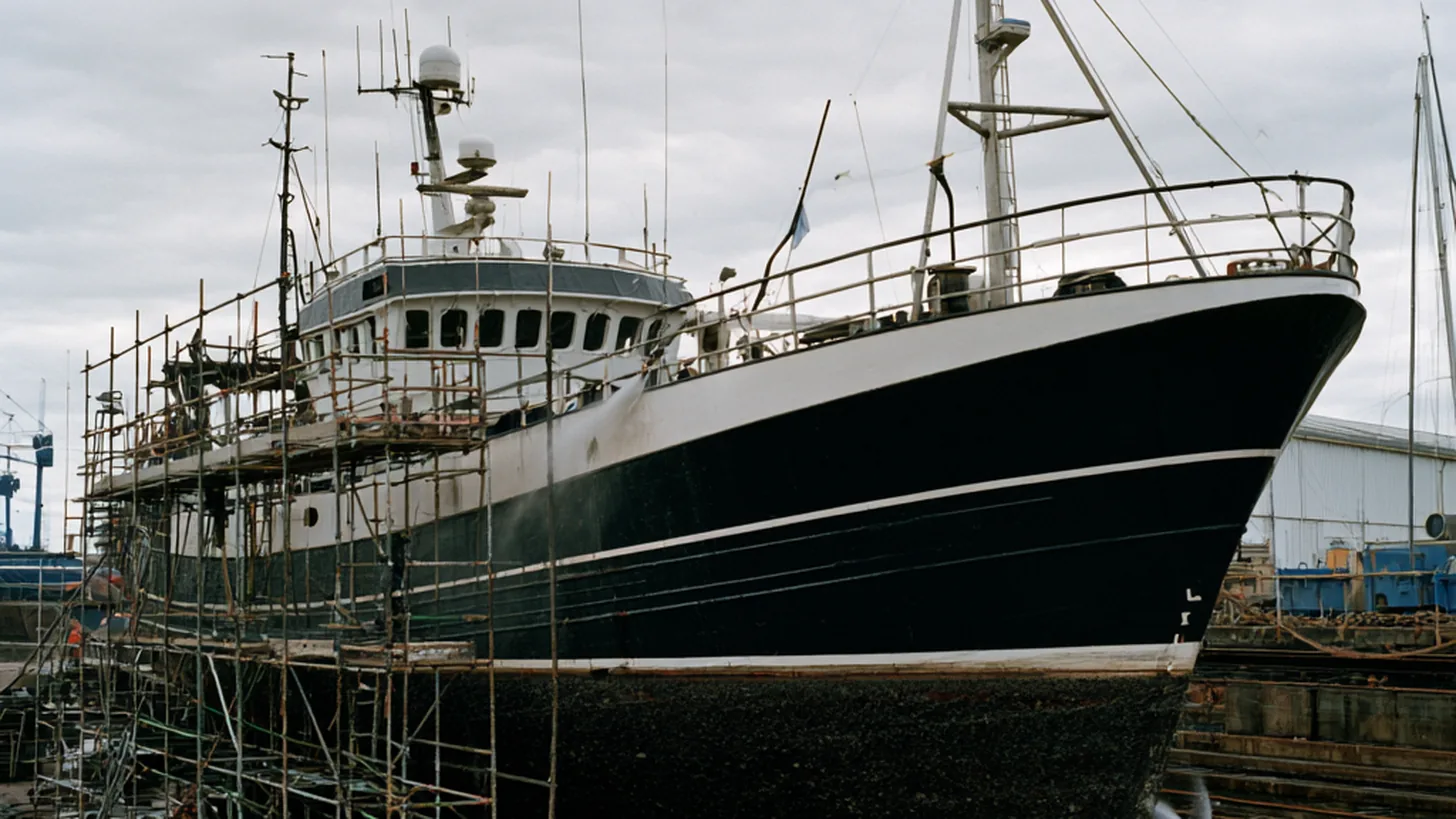
The key tasks under the hull: execution and documentation
Initial inspection and pressure washing
As soon as the vessel is stable on the blocks, the initial visual inspection begins. This first step is often rushed, yet it is decisive: it establishes the true condition of the hull before any work is done and forms the baseline of your maintenance record.
Procedure documented in the CMMS:
- 360-degree hull inspection: the operator walks the full circuit, systematically photographing each area (port, starboard, bow, transom). The CMMS allows these photos to be annotated directly to flag points of concern: heavy fouling, impact marks, early signs of osmosis, paint delamination.
- High-pressure washing: removal of shellfish, weed and biofilm. The water temperature and the pressure used are recorded in the work order, because these parameters affect both cleaning efficiency and surface preparation for the antifouling.
- Post-cleaning documentation: fresh photographs of the cleaned hull to assess the real condition of the substrate (cracks, osmosis blisters, wear of the old coating). These before and after images are the proof of methodical work.
This photographic traceability proves its value in any dispute with a contractor, or in a claim to your insurer concerning a pre-existing hull condition.
Sacrificial anodes: measurement and planned replacement
Anodes are the cathodic protection system for every submerged metal component: propeller, shaft, skin fittings, rudder. Inspecting them rigorously is what prevents galvanic corrosion.
Standardised CMMS procedure:
- Visual inspection: confirm that no paint covers the anode, since paint acts as an electrical insulator
- Wastage measurement: estimate the percentage of wastage against a new anode. The CMMS can store reference photographs or dimensional templates to make this assessment easier
- Replacement criterion: systematic replacement once wastage exceeds 50% (a configurable threshold depending on the operating profile)
- Full traceability: recording the make, model, weight and material of the anode (zinc in salt water, magnesium in fresh water, aluminium for mixed service)
The CMMS calculates the wastage rate of the anodes against the time elapsed since the last haul-out. This historical data sharpens replacement forecasts and lets you order ahead for the next haul-out. For the detail of materials and sizing, see our complete guide to anodes.
Skin fittings and valves: safety and watertightness
Every skin fitting 鈥� discharge, sea water inlet, log transducer 鈥� is inspected in detail:
CMMS check points:
- Valve condition: free rotation through the full travel, no seizing
- Seals: visual check, no cracking or hardening
- Fastenings: correct tightness, no corrosion
- Greasing of valve spindles (type and quantity of grease recorded)
For each skin fitting, the CMMS displays the history of previous work and flags when preventive replacement of the seals is due, following the interval recommended by the manufacturer.
Shaft line, propeller and rudder: detecting mechanical defects
Shaft line:
- Measurement of axial and radial clearance (values recorded in millimetres)
- Ultrasonic inspection of the bearings if abnormal clearance is found
- Condition of the stern tube (corrosion, cracking)
Propeller:
- Blade inspection (impact damage, fatigue cracking, cavitation erosion)
- Static balancing if distortion is suspected
- Condition of the shear pin or the retaining nut
Rudder:
- Clearance in the pintles and gudgeons (upper and lower bearings)
- Inspection of the rudder stock (corrosion, excessive clearance)
- Condition of the cathodic protection (rudder anode)
All these readings are centralised in the work order, allowing year-on-year comparison and early detection of degradation trends. It is the same logic that drives a preventive maintenance plan: a single reading tells you nothing, a series of readings tells you everything.
Stern gland: lubrication and preventive maintenance
The stern gland seals the point where the propeller shaft passes through the hull. Its maintenance bears directly on the safety of the vessel.
CMMS procedure:
- Checking the characteristic drip rate with the engine running, against the setting specified by the manufacturer
- Inspection of the packing (wear, drying out, signs of overheating)
- Retightening or renewing the packing as required
- Greasing the system (quantity and grease reference recorded)
The CMMS keeps the full history of work on the stern gland, including the date the packing was last renewed. That traceability lets you plan the renewal before the gland starts to drift, on the basis of how hard the vessel has actually been worked rather than from memory.
Applying the antifouling: choice and follow-up
Choosing the right antifouling: a built-in decision matrix
The antifouling you choose determines both the protection of your hull and the performance of the vessel. The CMMS can hold a decision matrix based on:
Operating criteria:
- Water type: salt water (conventional copper-based antifouling), fresh water (copper-free antifouling), mixed operation (a versatile formulation)
- Geographic area: warm waters (aggressive biofilm), temperate waters, cold waters
- Time at anchor or alongside: intensive operation (self-eroding antifouling), extended lay-up (hard matrix)
- Average speed: slow-speed vessel, fast craft
Regulatory criteria:
- Compliance with local environmental restrictions
- Prohibition of certain biocides in protected areas
- Specific requirements from your insurer
Full traceability in the work order. For each haul-out, the CMMS records:
- The exact make and product reference of the antifouling used
- The number of coats applied (barrier coat, primer, topcoat)
- The quantity consumed in litres, allowing cost per square metre to be calculated and stock to be managed
- The application conditions: ambient temperature, humidity, drying time observed between coats
- Photographs of the application, which document the quality of the work and serve as a reference for judging how well the product performed at the next haul-out
Keeping this history lets you refine your choice of antifouling progressively, comparing the state of fouling from one year to the next against the product used. If a particular antifouling proves more effective in your operating area, that knowledge is captured in the vessel maintenance record.
Assessing effectiveness: documented feedback
At the following haul-out, the operator visually assesses the state of fouling and scores the performance of the previous antifouling:
- Excellent: hull almost clean, minimal biofilm
- Good: light fouling, easily removed
- Average: moderate fouling requiring prolonged pressure washing
- Poor: shellfish firmly attached, significant loss of performance
This assessment, combined with the vessel's operating data (running hours, miles covered, areas visited), allows the antifouling strategy to be refined continuously. It also has a direct operational value: a fouled hull loses speed at constant power, and therefore burns more fuel. Monitoring fuel consumption between two haul-outs is the best judge of how a coating is really performing.
Closing out and history: the auditable haul-out report
Complete recording of operational and financial data
Closing the work order turns everything collected into information you can actually use to manage and improve your preventive maintenance.
Operational data:
- Labour hours: time spent per task (cleaning, inspection, antifouling application), which shows where the hours really go
- Unplanned work: defects found that required corrective action (repair of water ingress, gelcoat touch-up, replacement of a defective valve)
- Technical observations: anything worth watching more closely at the next haul-out
Financial data:
- Cost of spare parts: anodes, antifouling, seals, consumables
- Labour cost: internal valuation or contractor invoicing
- Total haul-out cost: consolidated so that one year can be compared with the next
The CMMS produces key performance indicators such as the cost per square metre of hull treated, the ratio of preventive to corrective maintenance, and the trend in haul-out cost from one campaign to the next. These metrics put hard numbers behind your maintenance strategy and let you defend the upkeep budget with figures from your own vessels rather than with estimates.
The haul-out report: a technical reference file
When the work is complete, the CMMS generates a complete, auditable haul-out report. This structured document contains:
Administrative section:
- Vessel identification (name, registration, type)
- Date of lift-out and of relaunch
- Identification of everyone involved (in-house technicians or external contractors)
- Time-stamped electronic signature confirming the work was carried out correctly
Technical section:
- Full list of tasks with their validation status (done, deferred, not applicable)
- Results of measurements and inspections (anode wastage, shaft clearance, valve condition)
- Before and after photographs of every critical area
- List of non-conformities found and the corrective actions taken
Logistics section:
- Complete list of parts consumed (references, quantities, suppliers)
- Traceability of the products applied (antifouling, greases, sealants)
- Storage and application conditions
Financial section:
- Breakdown of costs by heading (labour, parts, consumables, equipment hire)
- Comparison against the budget
Traceability for the insurer: compliance as legal protection
This auditable haul-out report is your best protection against the demands of marine insurers. In the event of a claim involving:
- Hull osmosis: the report proves that preventive inspections were carried out at the correct intervals and that the condition of the hull was regularly documented
- Shaft line or stern gland failure: the inspection and maintenance history shows that preventive measures were in place
- Galvanic corrosion: traceable anode replacement on a preventive schedule rules out any suggestion of neglect on your part
Many insurers now require a complete vessel maintenance record before settling certain types of claim. A handwritten notebook and a folder of scattered invoices no longer suffice. A marine CMMS turns that constraint into an operational advantage by producing the documentation with no extra effort on your part.
And when the time comes to sell the vessel, a complete and traceable maintenance history reassures the buyer about how the vessel has been looked after, and holds its ground in the negotiation.
The annual haul-out checklist, point by point
Here is the full checklist, set out as it would be configured in a haul-out work order. Every line is a traceable task: an acceptance criterion, a value to record, a piece of evidence to attach. The thresholds given are starting points, to be adjusted for the vessel, its operating area and the manufacturers' recommendations.
Before and during the lift-out
| Check point | Criterion or expected value | To record in the work order |
|---|---|---|
| Opening the haul-out work order | Calendar due date, running hours or miles run reached | Trigger date and triggering criterion |
| Availability of parts and products | Anodes, antifouling, seals and consumables above minimum stock level | References and quantities reserved |
| Lifting strops and spreader beam | Strops marked and free of cuts, spreader beam set on the lifting marks | Photograph of the lifting arrangement |
| Cradle and blocking | Blocks suited to the hull form, distribution of bearing points confirmed | Sketch or photograph of the blocking |
| Weather conditions | Wind and swell compatible with the lifting operation | Wind and swell readings, go or no-go decision |
| Isolating the systems | Sea water inlets closed, cooling circuits isolated | List of valves closed, operator sign-off |
| Lift-out | Operation completed without contact or slipping | Exact date and time, crane operator signature |
Hull, underwater body and submerged gear
| Check point | Criterion or expected value | To record in the work order |
|---|---|---|
| 360-degree inspection before washing | Initial condition recorded on all four aspects | Photographs port, starboard, bow, transom |
| High-pressure washing | Hull cleared of shellfish, weed and biofilm | Pressure and water temperature used |
| Condition of the substrate after washing | No blisters, cracking or paint delamination | Annotated photographs of doubtful areas |
| Osmosis | No blisters; where in doubt, moisture reading of the laminate | Location and size of blisters, moisture level |
| Hull, shaft, propeller and rudder anodes | Renewal once wastage exceeds 50%, no paint on the anode | Percentage of wastage, material, weight, reference |
| Continuity of the cathodic protection | Bonding continuous between submerged components | Continuity value measured |
| Skin fittings and valves | Free rotation through the full travel, no seizing or corrosion | Condition, greasing, date of last seal renewal |
| Strainers and inlet grilles | Passages clear, fastenings sound | Photograph after cleaning |
| Shaft line | Axial and radial clearance within the manufacturer's tolerance | Values in millimetres, compared with last year |
| Stern tube and bearings | No corrosion, cracking or ovalisation | Observations and photographs |
| Propeller | Blades free of impact damage, fatigue cracking and cavitation erosion | Photographs of the blades, balancing decision |
| Rudder, stock and fittings | Upper and lower bearing clearance within tolerance, stock free of corrosion | Clearance measured, condition of the rudder anode |
| Stern gland | Packing supple, no sign of overheating, drip rate set | Date of last packing renewal, grease used |
| Echo sounder, log and cable glands | Transducers clean, seals sound | Photograph, renewal if required |
Antifouling
| Check point | Criterion or expected value | To record in the work order |
|---|---|---|
| Assessment of the previous antifouling | Fouling score: excellent, good, average or poor | Score given, photographs before washing |
| Product selection | Formulation suited to the water type, the area and the operating profile | Make, reference, reason for the choice |
| System compatibility | Compatibility with the existing coating confirmed, or full removal | Previous product, overcoating decision |
| Surface preparation | Substrate dry, abraded and free of dust | Abrasive grade used, drying time observed |
| Application conditions | Ambient temperature and humidity within the manufacturer's range | Temperature and humidity readings |
| Application | Number of coats per the data sheet, overcoating intervals observed | Number of coats, litres consumed |
| Special areas | Propeller and shaft treated with a product suited to running gear | Product used on the propulsion components |
| Local restrictions | Biocides permitted in the operating area | Reference of the local rules applied |
Relaunch and close-out
| Check point | Criterion or expected value | To record in the work order |
|---|---|---|
| Final valve check | Every valve operated and left in the intended position | List and position, operator sign-off |
| Tightening and locking | Propeller nut locked, clips and fastenings retightened | Torques applied where specified |
| Launching | No water ingress found in any compartment | Bilge check immediately after launch and again one hour later |
| Engine and shaft line trial | No abnormal vibration, stern gland temperature stable | Temperature readings and observations |
| Outstanding non-conformities | Every unresolved defect carried into a corrective work order | Number of the corrective work order raised |
| Closing the work order | All tasks set to done, deferred or not applicable | Labour hours, parts cost, time-stamped signature |
| Next due date | New due date calculated from the relaunch date | Date and reference counter reading |
This framework transfers straight into a CMMS: each line becomes a task in the haul-out job plan, with its input field, its mandatory photograph and its acceptance criterion. Run two haul-outs against the same framework and the data becomes comparable 鈥� that is where the value appears.
Turning the haul-out into a lever for performance
The annual haul-out should not be seen as a logistical and financial burden, but as an investment in the longevity and performance of the vessel. By structuring this complex operation around a marine CMMS, you turn a string of repetitive tasks into a traceable, auditable preventive maintenance process.
The concrete benefits are these:
- Stronger safety: early detection of critical defects (corrosion, mechanical clearance, loss of watertightness) before they turn into damage
- Cost under control: spare parts anticipated, dead time at the yard removed, fewer repairs you did not choose because the drift is seen in time
- Compliance held: automatic production of the documentation insurers and maritime authorities ask for
- Asset value: a complete maintenance history that holds its ground at resale
- Peace of mind: the certainty that the vessel is maintained to a professional standard, with every job fully traceable
Each haul-out enriches the knowledge base for the vessel, sharpens the maintenance forecasts and improves the framework for the next one. The accumulated data becomes real informational capital, letting you decide on facts. To see how this framework is configured for your own fleet, let us talk about your set-up.
Glossary of technical terms
CMMS (Computerised Maintenance Management System): software that automates, records and optimises all maintenance operations on a vessel. It structures the follow-up of work, the management of spare parts and the production of auditable reports.
Sacrificial anode: a metal component (zinc, aluminium or magnesium) fitted to the submerged parts of the vessel to protect the nobler metal components (propeller, shaft, rudder) from galvanic corrosion. The anode corrodes in place of the other metals and must be renewed regularly.
Antifouling: marine coating applied to the underwater body to prevent marine organisms (weed, shellfish, biofilm) from attaching. A distinction is drawn between self-eroding (self-polishing) antifoulings and hard matrix antifoulings.
Self-eroding antifouling: a type of antifouling whose binder dissolves progressively in contact with water, releasing the biocide in a controlled way. Suited to vessels in regular service, it has the advantage of not building up layers from one year to the next.
Stern gland: the sealing device where the propeller shaft passes through the hull. It usually consists of grease-impregnated packing that must be adjusted to allow the characteristic slight drip.
Shaft line: the mechanical assembly that transmits engine power to the propeller, comprising the shaft, bearings, seals and stern tube. Correct alignment and the absence of clearance are critical to reliable propulsion.
Work order: the document or digital record describing a maintenance job to be carried out. It sets out the tasks, the resources needed and the safety instructions, and it records the execution and the results of the job.
Preventive maintenance: a maintenance strategy that intervenes on equipment before a failure occurs, either on a planned schedule or on condition indicators. It stands in contrast to corrective maintenance, which repairs after breakdown.
Osmosis: a hull condition caused by water penetrating the polyester laminate, producing blisters and progressive degradation of the composite. Catching it early at a haul-out avoids expensive repairs.
Drydocking is the high point of an annual maintenance cycle whose organisation we describe in the maritime CMMS guide.


