

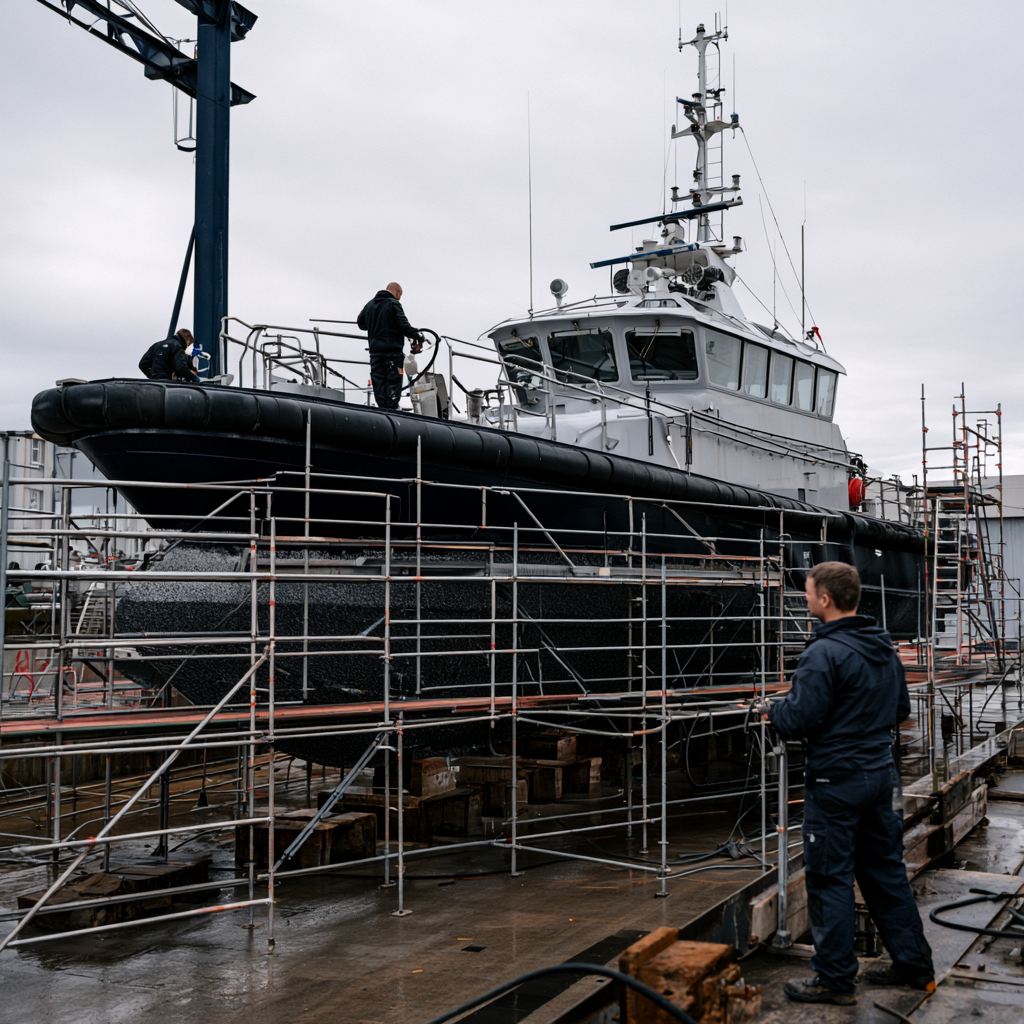


It is 03:40, a 300-metre container ship is approaching the pilot boarding ground, and the station has forty minutes to put a pilot on her ladder in a steady 25 knots of wind. At that moment, nobody asks whether the duty launch has been well looked after: she sails, or the port slows down. That is what makes pilot boat maintenance unlike any other upkeep programme at sea. It does not prepare a season or a voyage; it guarantees a departure within minutes, 365 days a year, from a fleet of only two to five boats.
A pilot station lives on that promise. Behind it are launches absorbing 2,000 to 4,000 engine hours a year — more than many commercial ships —, repeated contacts with moving hulls, and a technical team of two or three people keeping several units serviceable at all times. When a boat is missing from the line-up, no contract quietly slips: ship movements wait, terminals fall out of sequence, and the responsibility lands squarely on the station.
This article sets out how pilot stations organise that availability in practice: the unusually punishing duty profile of a pilot boat, maintenance triggered on actual engine hours rather than the calendar, fleet-level arbitration when one unit goes to the yard, and what a multi-vessel CMMS actually changes for a small technical team.
A duty profile that wears faster than deep sea
On paper, a pilot boat is a simple vessel: 15 to 20 metres, two high-speed diesels, a wheelhouse and fendering. In service, it is one of the most severe operating profiles in the industry, and engine manufacturers acknowledge it explicitly by placing this duty in their harshest load-profile categories.
- Short, repeated cycles: ten to thirty sorties a day in a busy port, twenty minutes to two hours each, with immediate demands for full power, sometimes on an engine barely up to temperature. The number of hot-cold cycles ages the machinery faster than the hours themselves.
- Full load as routine: a transfer means matching the piloted ship's speed, often 10 to 12 knots alongside, then clearing away smartly. These engines spend an unusual share of their lives near maximum continuous rating.
- Hull impacts at every transfer: coming alongside a moving steel wall, in chop, thousands of times a year, loads the fendering, the structure, the engine mounts and the shaft lines in a way no other trade does.
- Permanent spray: bridge electronics, searchlights, man-overboard recovery gear and electrical circuits live in salt, continuously.
- No natural off-season: unlike a ferry or a fishing vessel, there is no built-in lay-up period of several weeks. Every immobilisation has to be negotiated against operations.
The direct consequence is that due dates come round fast and often. A launch running 3,000 hours a year with oil changes at 250-hour intervals goes through that single job twelve times a year, per engine. Add turbochargers, injectors, gearboxes, shaft seals, anodes, pump impellers, safety equipment checks and statutory surveys, and a station operating three or four boats accumulates several hundred due dates a year. The standard marine diesel maintenance schedule by hour bands remains the foundation — it simply runs two to three times faster here than anywhere else.
Why does 24/7 availability change the whole logic of pilot boat maintenance?
Because the unit of account is the station, not the boat. A conventional operator thinks vessel by vessel: each unit has its own plan, its own downtime, its own budget. A pilot station thinks in residual capacity: at any moment there must be at least one boat manned and ready at the pontoon — ideally two in a major port — whatever work is in progress elsewhere in the fleet. The question is therefore never "when is this boat due for service?" but "which jobs can I run this week without dropping below my availability threshold?".
That reversal has three practical consequences. First, maintenance is planned at fleet level, not unit level: sending a boat to the yard is only possible when the due dates of the others are under control. Second, preventive work takes priority over everything else: one unanticipated breakdown on a three-boat fleet removes a third of the capacity in a single stroke. Third, any slippage in the tracking is punished immediately: a missed service cannot be quietly caught up during a slack season that does not exist.
It is exactly the scenario every station dreads: launch No. 2 immobilised by a gearbox failure on the weekend No. 1 is at the yard for her annual haul-out. That weekend, the station runs on a single boat — and every sortie becomes a gamble.
Pilot boat maintenance: trigger on engine hours, not the calendar
A station's activity is irregular: 320 engine hours in August when port calls stack up, 140 in January. A purely calendar-based plan — "oil change every two months" — over-services the winter and under-services the summer, precisely the wrong way round. Over-maintenance burns parts and downtime for nothing; under-maintenance eats into the engine maker's safety margin at exactly the time of year the boats are working hardest.
The approach that works, and that pilot stations equipped with 91Â鶹¾«Ʒ apply daily, is to trigger jobs on actual running-hour counters. The mechanism takes three steps: the crew logs the counters at the end of each watch from the mobile app, including offline at the pontoon or at sea; the CMMS projects the likely date of every due item from the observed usage rate; and the work order is raised automatically when the threshold is crossed — 250, 500, 1,000 hours — or a few dozen hours beforehand, leaving time to order the parts.
| Interval | Typical jobs on a pilot boat | Real-world frequency at 3,000 h/year |
|---|---|---|
| Every watch handover | Levels, pre-start checks, MOB recovery gear test, counter readings | Daily |
| 50 h | Sea water strainers, impeller check, visual fastenings, fendering | Roughly weekly |
| 250 h | Engine oil change, oil and fuel filters, belt inspection | Monthly, per engine |
| 500 h | Gearbox oil, coolers, turbocharger check, engine anodes | Every two months |
| 1,000 h | Injectors, valve clearances per the maker, alignment, shaft seal | Three to four times a year |
| Annual / yard | Haul-out, hull anodes, sea valves, liferafts, extinguishers, statutory survey | One negotiated window per boat |
The exact intervals remain those of your engine maker and your approved plan; the table gives orders of magnitude. The point lies elsewhere: combined with a preventive maintenance plan kept boat by boat, hour-based triggering turns availability into something you can steer. Each unit shows its projected due dates as real calendar dates, and the decision to send a boat to the yard rests on figures rather than impressions. Our method for building a planned maintenance system in four steps applies to a launch fleet line for line.
Levelling wear across the fleet
A less obvious benefit of counter-based tracking is workload distribution. Without data, the coxswains' favourite boat — the newest, the most comfortable — takes 60 % of the sorties and ages twice as fast as her sisters. With counters up to date and visible, the station rotates the units to level the hours, schedules the heavy intervals into the quiet season, and avoids two boats arriving at the same major service in the same week.
Going further: the oil as a witness
On engines worked this hard, many stations add an oil sample at every change, or every other change. An oil analysis at around €40 a sample flags bearing wear, fuel dilution or water ingress months before the failure — and on a small fleet, every breakdown avoided is a boat that stays on the line.
Holding availability with two or three boats: the arbitration mechanics
The management rule of a pilot station fits on one line: never stack two avoidable unavailabilities. In practice, that is built with a few simple tools — provided they rest on current data.
- An explicit availability threshold: "never fewer than two boats manned" in a major port, "never fewer than one, with a mutual-assistance arrangement as backup" in a mid-sized one. Written down, this threshold becomes the arbitration rule for every non-urgent job.
- A consolidated fleet schedule: the due dates of all the boats on a single screen, projected into dates from the observed hour rate. This is the view that reveals collisions — two 1,000-hour services in the same fortnight — early enough to shift one of them.
- Yard windows negotiated in advance: each boat's annual haul-out is placed in the quiet season and prepared like a miniature refit — parts on hand and the work list frozen before she comes out of the water — to compress the immobilisation to a few days.
- A clean fallback to degraded mode: when the fleet drops to the threshold, work is limited to what safety strictly requires, and everything else is rescheduled automatically for the missing unit's return — which presupposes a maintained backlog, not a pile of sticky notes.
Two indicators are enough to steer the whole thing: availability per boat (hours ready for service over total hours) and the preventive ratio (share of maintenance hours planned before the due date rather than forced by failure). A healthy station keeps its preventive ratio above 80 %; below that, breakdowns are writing the schedule. The classic maritime maintenance KPIs — MTBF, MTTR, backlog — apply here per boat and per component, and the MTBF of the gearboxes is often the first figure that raises eyebrows.
What traceability spares the station
A pilot station operates under the eye of its national maritime authority, its insurers, sometimes a classification society, and increasingly a quality certification such as ISO 9001 — common among pilotage organisations. Several administrations also run dedicated survey regimes or codes of practice for pilot boats, and pilot transfer arrangements themselves are addressed by SOLAS. Whatever the exact framework, the pilot transfer is by nature a high-risk operation: after an incident — a fall during boarding, a hard contact, a propulsion failure on approach — the first question always concerns the launch's state of upkeep.
The difference between two stations is then measured in hours. The one running its maintenance in a CMMS produces a timestamped history within minutes: who worked on what, when, on which equipment, with which parts, against which manufacturer recommendation. The one running a binder and a spreadsheet opens weeks of reconstruction, with gaps the insurer and the investigator will always read against it. The same documentary base serves daily to prepare statutory surveys and certificate tracking for each boat — safety surveys, liferafts, extinguishers, life-saving appliances — with alerts ahead of every expiry.
There is a direct financial angle too. At renewal time, an insurer shown a CMMS extract with an 85 % preventive ratio and zero overdue surveys does not price the same risk as one facing a station that answers "everything is up to date" without being able to prove it. Several stations use precisely this argument at every renegotiation.
Technical handovers without memory loss
This is the most underestimated risk in pilot stations, because it never shows in the accounts. The senior mechanic who has known these engines for fifteen years knows which boat runs slightly warm above 1,800 rpm, which supplier delivers an impeller in 24 hours, which home-grown modification was made to No. 3's cooling circuit. The day he leaves — retirement, transfer, sick leave — all of that capital leaves with him if nothing was ever written down.
A CMMS turns that individual memory into station memory. Every job logged, every part fitted, every anomaly recorded builds a history that belongs to the organisation. The know-how itself is captured as maintenance job plans: the impeller replacement procedure specific to your engines, with torque values, known traps and exact part numbers, executable by a relief mechanic in his first week. Among the pilot stations using 91Â鶹¾«Ʒ, this is often the argument that carries the decision, before any calculation of maintenance savings: the certainty that the next handover will not start from zero.
What a multi-vessel CMMS must cover for a pilot station
Not every planned maintenance system suits this trade. A station evaluating a tool — or measuring what its spreadsheet really costs, an exercise we detailed in Excel vs maritime CMMS — can lean on this checklist:
| Requirement | Why it is decisive for a station |
|---|---|
| Consolidated fleet view | Availability arbitration is done across all boats at once; a single-vessel tool reproduces the spreadsheet's silos. |
| Hour-counter triggering | Calendar-based plans cannot follow an activity that doubles between seasons. |
| Mobile and offline | Readings and job reports are entered at the pontoon or on board, not at the desk in the evening; a sync queue means nothing is ever lost. |
| Stock shared between boats | Sister launches share filters, impellers and belts: one common stock, sized once, replaces three redundant crates. |
| Certificates and surveys with alerts | An expired safety survey takes a boat off the line as surely as a breakdown does. |
| Exportable history | Insurer, authority, quality audit: the evidence must come out in a few clicks. |
| Fast, simple data entry | The technical team is two or three people; a tool that needs a full-time administrator will never be kept up to date. |
On the stock side, the reasoning specific to small fleets deserves a word: critical spares — impellers, belts, sensors, shaft seals — are sized against the risk of immobilisation, not against the value tied up. Our article on critical spare parts management on board shows how to set those minimums and let the work orders trigger the reorders automatically.
Getting started without disrupting operations
The classic fear in a station is time: the technical team is already stretched, and operations never stop. In practice, rolling a CMMS out across a launch fleet is one of the fastest deployments in the maritime sector, precisely because the units are sisters: the equipment tree built for the first boat is duplicated onto the next ones.
- List the critical equipment on the first boat: engines, gearboxes, shaft lines, steering, electronics, life-saving appliances. One day is enough, and the structure is copied to the sister units.
- Import the makers' schedules: engine intervals, gearbox due items, statutory surveys. This is the skeleton of the preventive plan.
- Record the current counter readings and the jobs already due, so the projection starts true. Paper history can be back-filled later, as time allows, without holding up the start.
With guided onboarding, a three-boat station is operational within days, without taking a single unit out of service. The pitfalls are the same as for any CMMS rollout — trying to capture everything before starting, neglecting to train the reliefs — and we compiled them in our review of the mistakes that sink a CMMS project. To place the whole approach in context, from choosing the tool to tracking the indicators, the complete maritime CMMS guide walks through every stage.
In short
Pilot boat maintenance is played out at station level, not boat level. Engines absorbing 2,000 to 4,000 hours a year in short cycles, a fleet of two to five units and a 24/7 availability promise leave no room for improvisation: jobs are triggered on actual engine hours, the boats' due dates are consolidated on a single schedule, and every intervention leaves a timestamped record that protects the station before the authority, the insurer and the passage of time.
The spreadsheet and the senior mechanic's memory carried that tracking for years; they reach their limit as soon as the fleet passes two boats or a handover comes into view. A multi-vessel maritime CMMS with counter readings on mobile, offline included, turns availability into a quantity you steer rather than endure.
91Â鶹¾«Ʒ already equips pilot stations and gives them exactly that foundation: counters, boat-by-boat preventive plans, a fleet view, shared stock and an exportable history, in a CMMS built for fleets, designed in Marseille by seafarers and deployed on more than 700 vessels. Tell us about your station: a thirty-minute demonstration on your own launches is usually enough to make up your mind — and our per-vessel pricing is public.


